
Today, physical media has become almost a fossil. The Compact Disc (CD), once the shimmering golden standard for music and data storage, has largely been relegated to landfills and dusty attic boxes, replaced by invisible cloud storages. Yet, British light artist Bruce Munro sees something else in these discarded polycarbonate halos. In his monumental installation Water Lilies, commissioned for the Autostadt in Wolfsburg, Germany, Munro transforms the ghosts of the digital past into a beautiful vision of a future where technology and nature complement each other. This offers a striking masterclass in the United Nations Sustainable Development Goal of Responsible Consumption and Production.
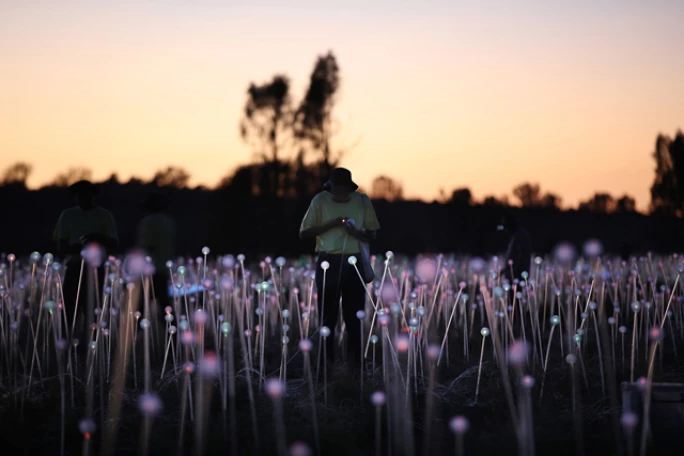
With a career that has spanned over 30 long years, Munro is renowned for his ability to turn the mundane human-made objects into the magical seemingly natural phenomenon. For example, his famous Field of Light used thousands of fiber-optic stems to illuminate the backyard of his family home in Wiltshire, just like the natural illuminations that occur at Red Desert in central Australia. Water Lilies strips back this concept even further. Inspired by the literature of C.S. Lewis—specifically the idea "Sea of Lilies" as a gate between worlds in The Voyage of the Dawn Treader—and the botany of the massive Victoria amazonica, Munro sought to create a false-garden that required no electricity to bloom and would only further bridge the gap between what is naturally occurring and what is human-made.
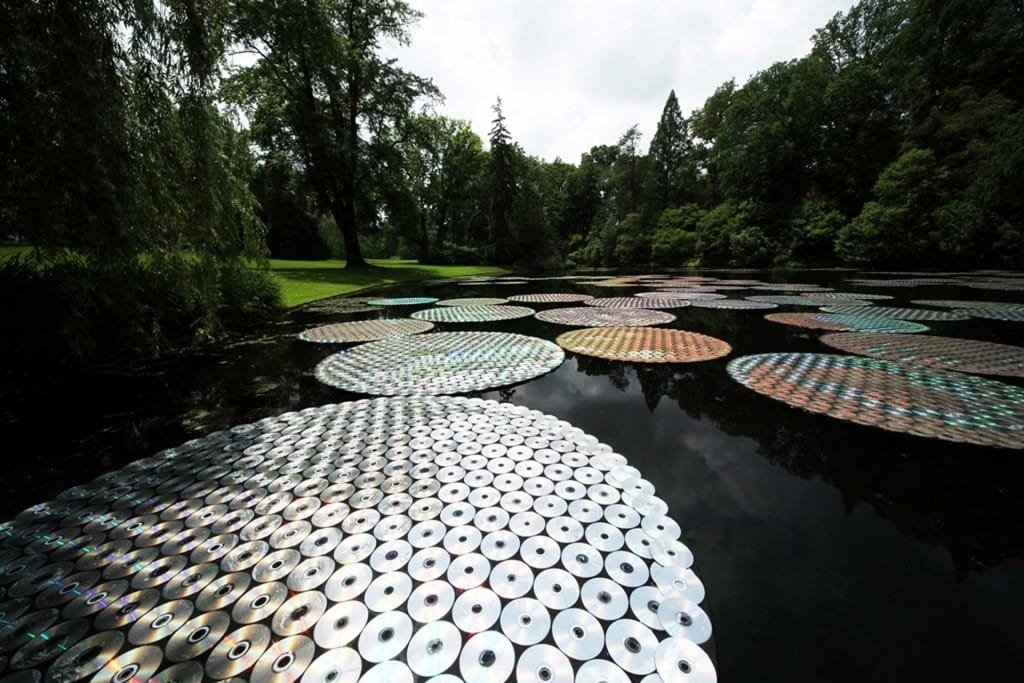
The scale of the project is staggering. The installation utilized approximately 65,000 recycled CDs, sourced and diverted from waste streams around the world. Flattened and arranged into vast circular pads, these discs float upon the water, with their mirrored surfaces catching the sunlight.
Here, the medium is the message. By using CDs, Munro taps into the readymade philosophy in art, where existing objects are repurposed to challenge its original meaning. But where Marcel Duchamp used a urinal to question art, Munro uses CDs to probe their status as e-waste. He invites audiences to look at materials that have collectively been discarded—plastic and aluminum—and see it not as garbage, but as resourceful materials that can still be repurposed.
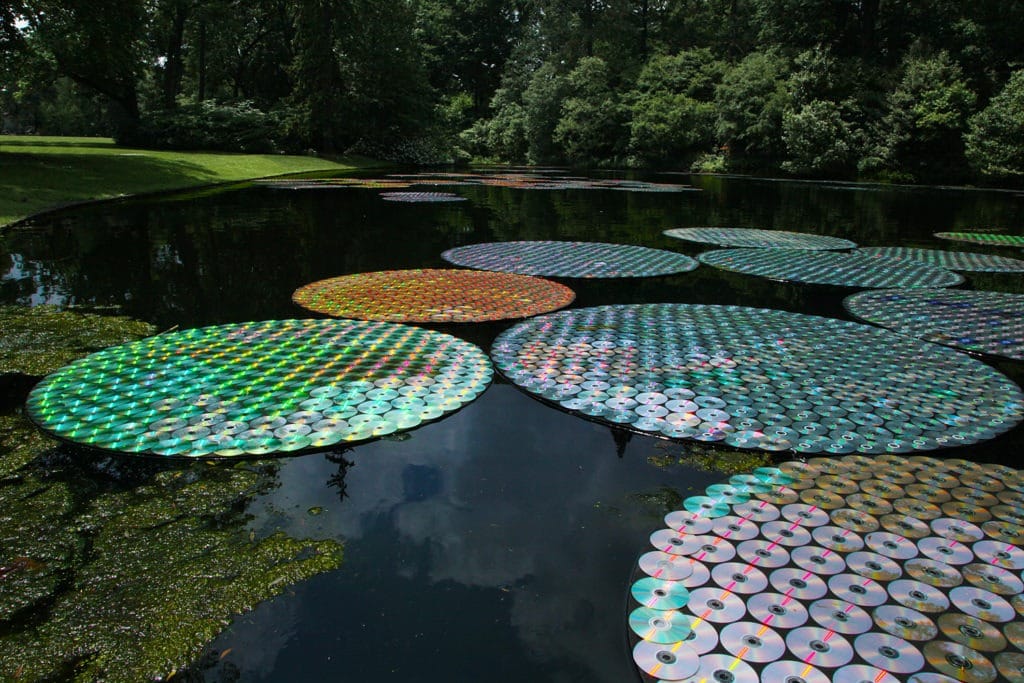
Unlike his fiber-optic works, Water Lilies is a passive installation. It does not consume energy; it simply reflects it. As the sun moves across the sky, the diffractive surfaces of the CDs break the light into a shifting spectrum of rainbows. The installation changes mood with the weather: brilliant and blinding at noon, soft and pearlescent at dusk. This reliance on natural resources mirrors the ethos of global sustainability. It is a visual metaphor for a future where humanity works with the environment rather than extracting from it.
Munro’s work challenges the linear "take-make-dispose" model of consumption. It suggests a circular creativity, where the end of a product's life cycle is merely the beginning of its further utility. The installation sits in the Autostadt, a center dedicated to the automotive industry—a sector currently grappling with its own transition toward sustainability. In this setting, the Water Lilies serve as a gentle but persistent reminder that innovation isn't always about inventing new materials, but about reimagining the ones we have already left behind. By moving these 65,000 discs from a landfill to a lake, he proves that with enough imagination, even our technological leftovers can help us find our way back to nature.
Explore more of Bruce Munro’s light installations on his official website, Instagram @brucemunrostudio or read about his studio practice via Sotheby’s and My Modern Met.