
Built to store salt—the "white gold" of the region—the Magazzino Del Sale in Cervia, Italy, an industrial-era architectural marvel, is defined by its expanse, its overwhelming presence, and its perceived permanence. Yet, in April 2025, the space hosted an exhibition that ponders concepts that defy its architecture: the tension of potential flight. Here, suspended against the rough-hewn brick and shadowed vaults, the kite works by Balinese artist and architect Kadek Armika were hung.
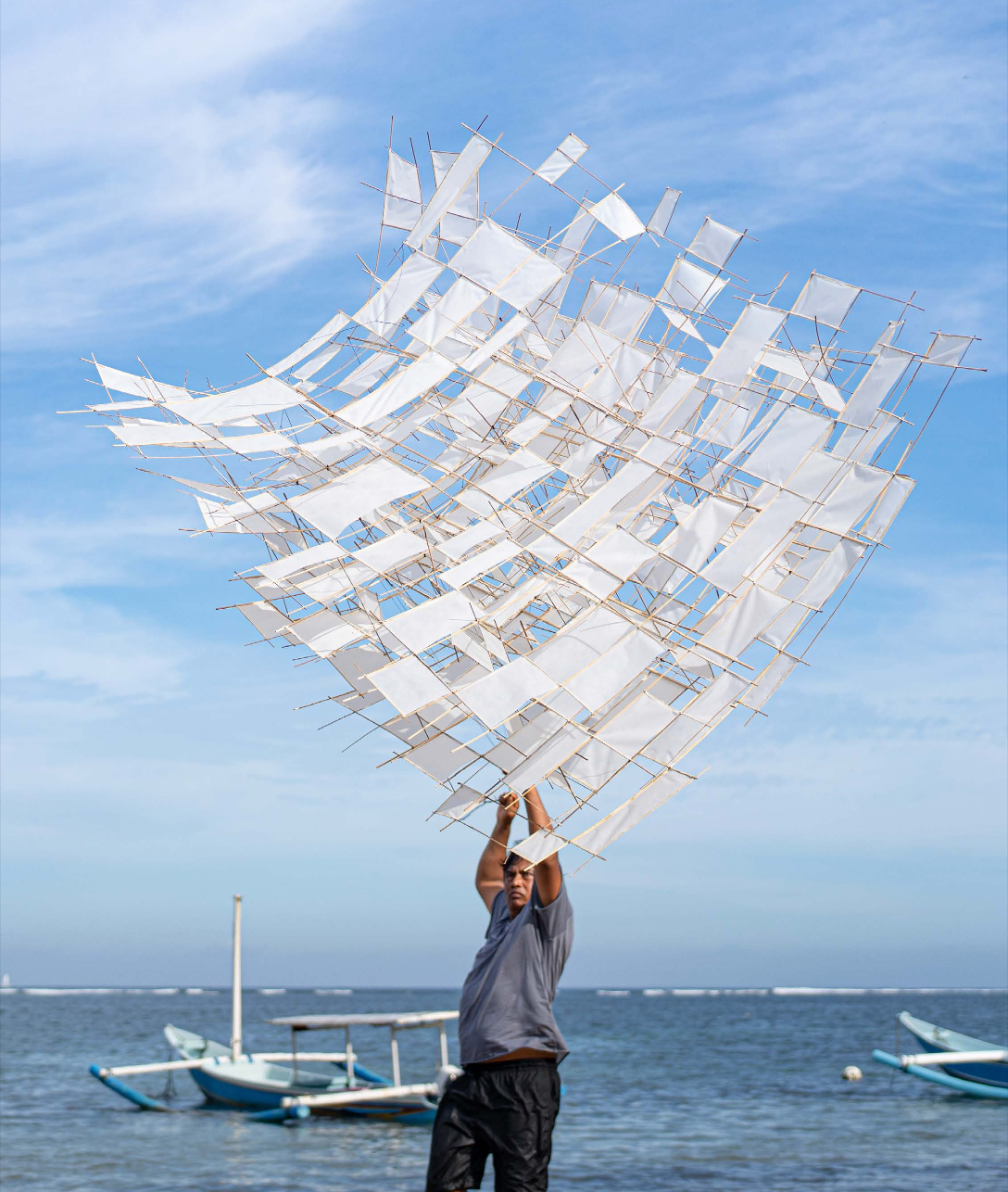
This was his solo exhibition titled Balance & Harmony. Written by his gallerist Krisna Sudharma, the show presented a seismic shift in how audiences understand kinetic sculpture. Running from April 19, 2025, the show brings Balinese culture to Europe and challenges the Western monopoly on modernism. In it, Armika transforms the humble kite—often dismissed in the West as child’s play or a craft object—into a medium of high-concept philosophical inquiry that elevates both the kite and the notion of "play." He offers a polycentric vision of art history, one that posits that the "mobile," a term coined by Marcel Duchamp, has existed in the Global South for centuries, not as a parlour curiosity, but as a spiritual technology connecting the earth to the heavens. This is why the exhibition is aligned with the United Nations Sustainable Development Goals of Good Health and Well-Being and Reduced Inequalities.
As Sudharma outlines, the history of Western kinetic art is frequently framed through a binary debated by Marcel Duchamp and Alexander Calder. Duchamp named the "mobile" to describe moving sculpture, while Jean Arp coined "stabile" for stationary works. For decades, this conversation was dominated by industrial materials: steel, wire and sheet metal, moving in response to air currents but ultimately detached from them.
Kadek Armika enters this dialogue not as a student but as a master of a parallel, ancestral tradition. His exhibition dismantles the binary of the mobile and the stabile by introducing a third element: the tether. In Armika’s view, a kite is neither fully mobile (it is anchored) nor stabile (it is in constant motion). It is a "negotiated object," existing in a state of dynamic tension.
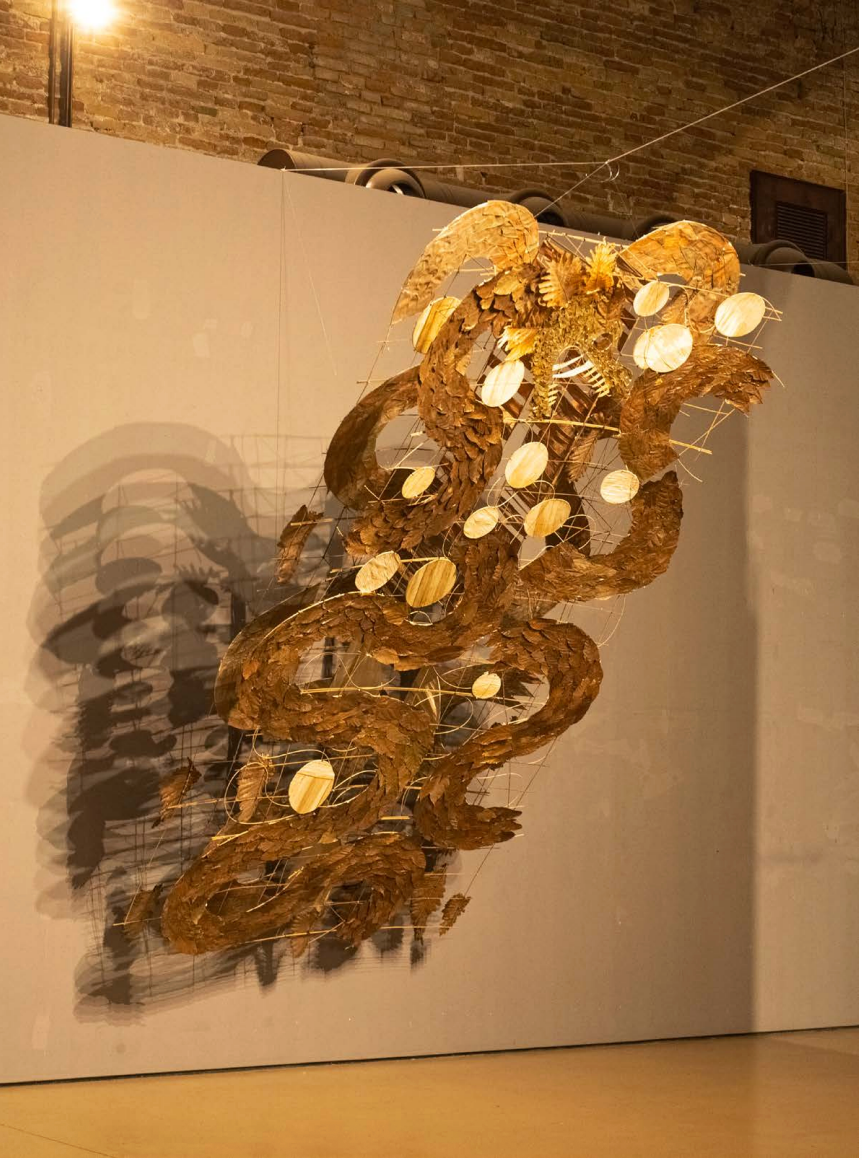
Drawing from indigenous Balinese forms, Armika reinterprets three distinct kite archetypes, elevating them from folk culture to fine art: The Bebean (The Fish). Traditionally symbolizing prosperity and the water element, it is designed with a wide, flat surface area that "swims" through the air. In the gallery, Armika strips this form down to its architectural skeleton, revealing the complex internal balance required to keep it aloft. This form represents the "Stabile in motion"—a large presence that commands space through rhythmic, predictable undulation.
Meanwhile, the Janggan (The Dragon) forms the centrepiece of the exhibition’s kinetic inquiry. In Balinese mythology, the dragon links the underworld to the sky. It is defined by its tail, which in traditional festivals can reach lengths of over 100 meters. Armika treats the Janggan’s tail as a kinetic line drawing in space—a ribbon of energy that visualizes the invisible currents of wind (or, in the gallery, the flow of human movement).
Finally, the Pecukan (The Leaf), which has notoriously been known as the most technically difficult kite to fly, mimics the erratic, tumbling motion of a falling leaf. It relies on instability to generate lift. Armika uses this form to challenge the modernist obsession with order and symmetry, embracing chaos and fragility as essential components of balance.
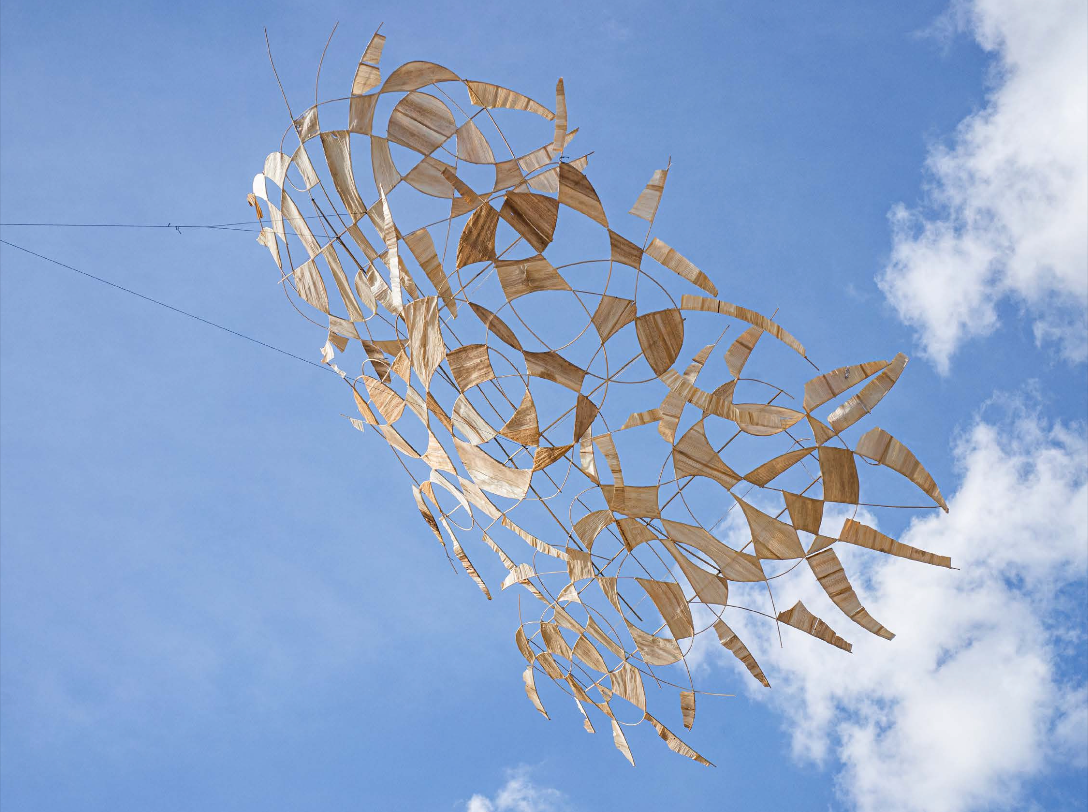
While the aesthetic of Balance & Harmony soars internationally, its materiality is deeply grounded in the soils of traditional Indonesian goods production, offering a critique of industrial art production. Especially in the contemporary world of sculpture and aeronautics, where the trend calls for synthetic perfection—carbon fibre, ripstop nylon and plastic polymers. These materials are "immortal" in the worst sense. They do not decay, contributing to the global waste crisis. Armika, however, is a material philosopher who returns to the source. His sculptures, including the pivotal work Tantra (2025), are constructed from bamboo, rattan and dried banana leaf, organic materials typically found in traditional Indonesian objects, architecture and interiors.
This is not an outright rejection of modern technology, but a re-evaluation of it. Armika treats bamboo as organic steel. He shows how it possesses a tensile strength that rivals metal but retains a flexibility that allows it to absorb the energy of the wind rather than resisting it. By utilizing these biodegradable materials, Armika introduces the concept of a lifecycle to the artwork. This kite, which was born from the earth (bamboo and cotton), now lives in the sky, and eventually, it can return to the earth without leaving a toxic footprint.
Furthermore, works like Sustainability (2025) utilize these organic materials to visualize the delicate equilibrium of ecosystems. If the frame (structure/society) is too rigid, it snaps in the wind (nature/climate change). If it is too loose, it fails to fly. Armika uses the kite as a pedagogical tool for environmental resilience, teaching viewers that survival requires the ability to bend.
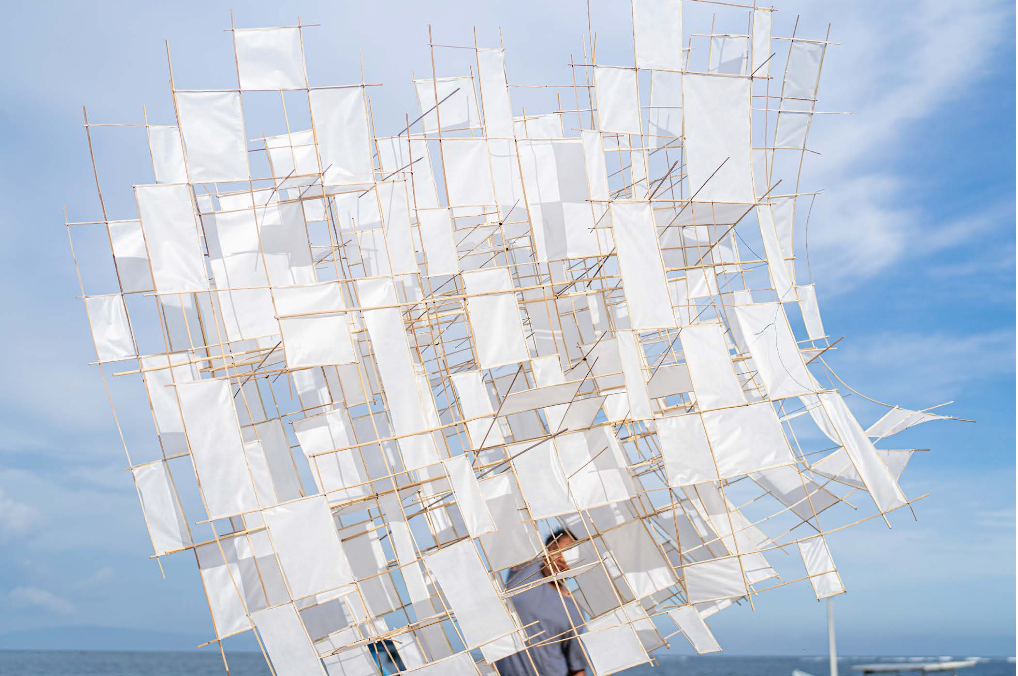
Beyond environmental implications, Balance & Harmony champions the preservation of Intangible Cultural Heritage. In a rapidly urbanizing world, traditional practices are often pushed to the margins or commodified into souvenirs for tourism. This process, often called "Disneyfication," strips cultural objects of their spiritual and social context.
Armika fights this erasure by placing the kite within the white cube (or in this case, the brick vault) of the contemporary art institution. He asserts that the Balinese kite is not merely a toy, but a sophisticated architectural feat developed over generations of communal labour in the Banjar (village community). In Bali, kite flying is a communal act that activates the sky as a public space. It requires coordination, shared knowledge, and a collective respect for the elements. By bringing this ethos to Cervia, Italy, Armika suggests that sustainable communities are built not just on green infrastructure, but on shared cultural identities and polycentric exchanges. He connects the rice fields of Denpasar to the salt flats of Cervia, creating a bridge between two coastal cultures that understand the power of the wind.
Ultimately, Balance & Harmony forces the viewer to look upward, both literally and metaphorically. In Magazzino Del Sale, Kadek Armika’s static sculptures seem to vibrate with potential energy. They are reminders that the divide between the "traditional" and the "modern" is an artificial construct. Armika proves that the ancient technology of the kite—a frame, a skin, and a tether—remains one of the most sophisticated devices we have for understanding humanity’s place in the world. It teaches people that to fly, they must be anchored. To progress, they must look back, and to create a sustainable future, they must understand the winds that drive us. The golden bag of heritage must be opened, not to sell its contents, but to let them fly.
To explore the artist's portfolio and the exhibition catalogue, visit his Instagram @armika_kadek or Nonfrasa Gallery’s website.