
Silence today has become a luxury. Everyday we find ourselves sieged by a relentless stream of notifications, headlines and digital demands, a mental overload that leaves little room for inner peace. Here in the constant noise, the work of South Korean artist Kim Young-jin offers a visual sense of quietness. His latest series, Humming Garden, is a prescription for the modern mind, as he uses dots to paint flowers, creating a labour intensive piece that soothes both the viewer and the creator. This therapeutic approach to artistic creation directly aligns with the United Nations Sustainable Development Goal of Good Health And Well-Being.
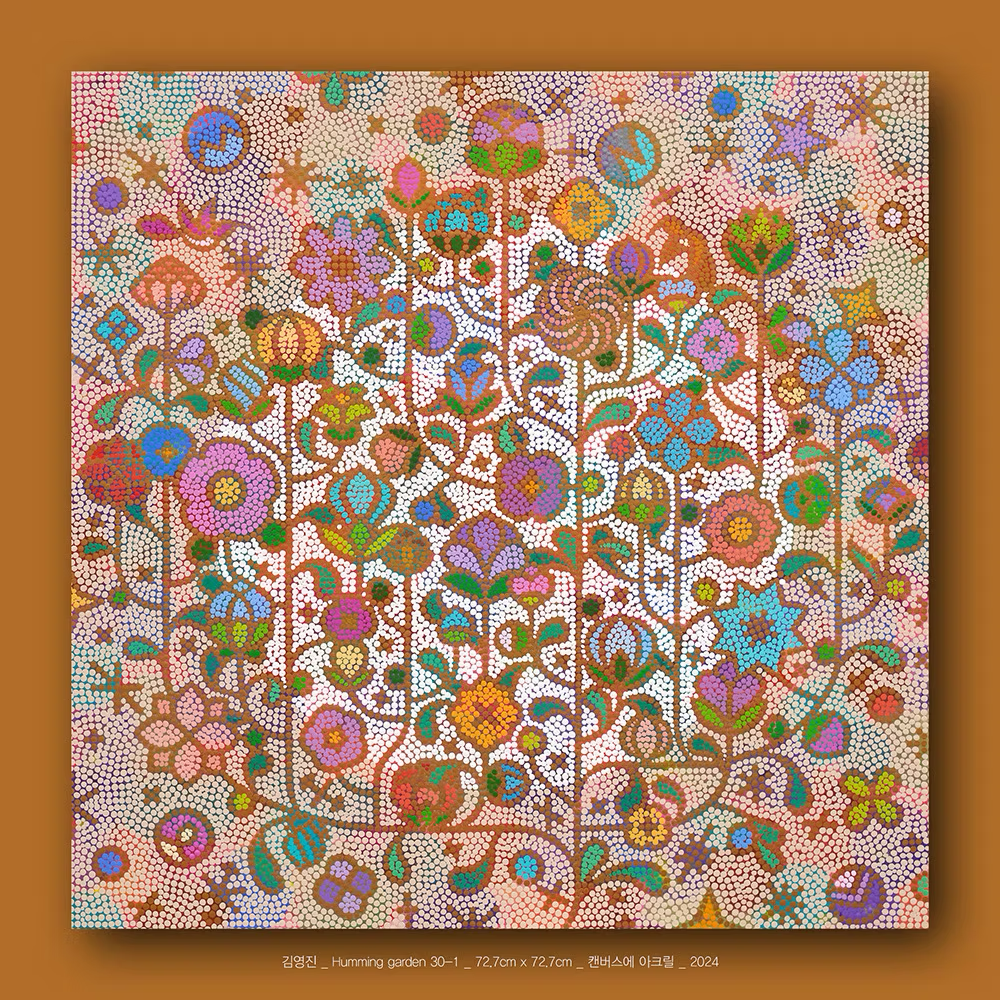
At first glance, Kim’s work evokes the scientific precision of Georges Seurat and the 19th-century Pointillists. Like Seurat, who sought to blend light through the optical mixture of adjacent colors, Kim constructs his images through the accumulation of thousands of minute dots. However, where Seurat’s dot was a calculation of optics, Kim’s dot is an act of presence. His technique is less about how the eye perceives color and more about how the mind perceives time.
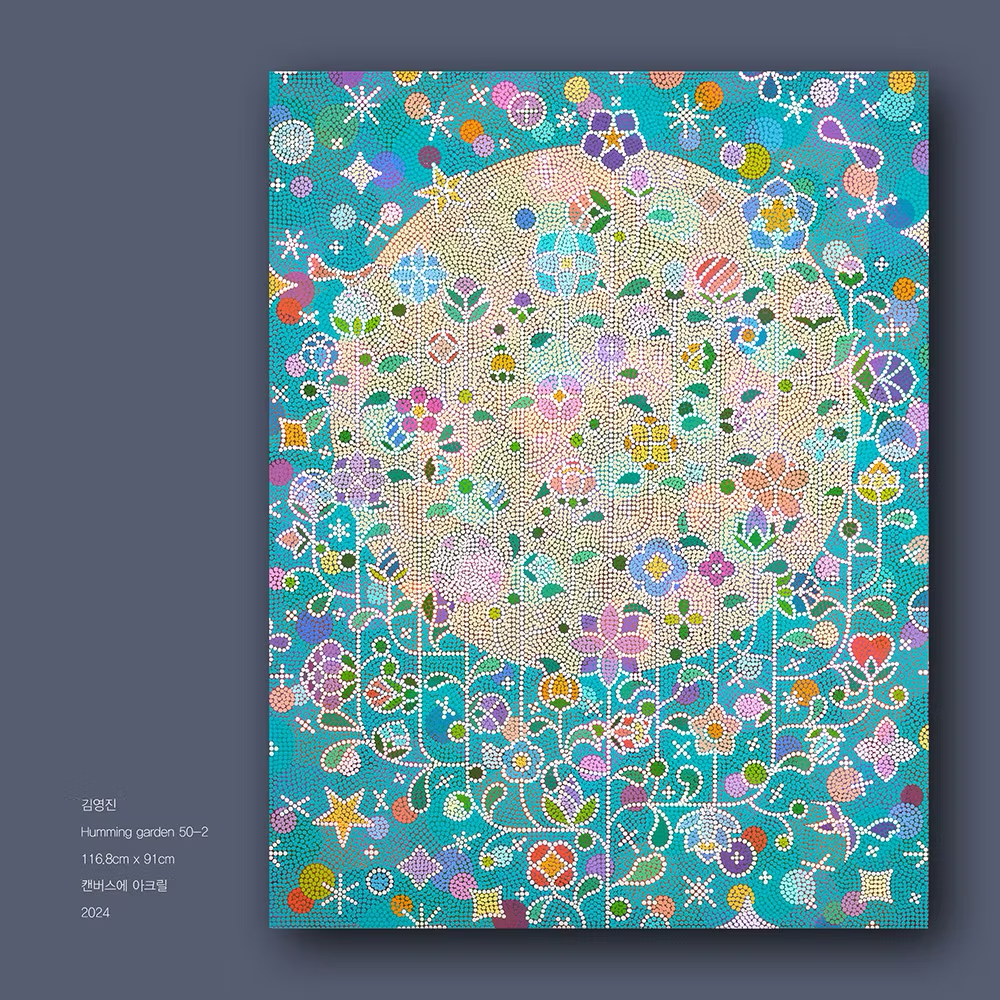
The process behind Humming Garden is one of grueling, repetitive labor. Kim meticulously layers dots and small strokes to form landscapes and abstractions that seem to vibrate with a quiet energy. This repetition is intentional. In psychology, repetitive physical actions—like rosary beads passing through fingers or the rhythmic breathing of yoga—are known to induce a state of "flow" or mindfulness. By engaging in this disciplined, almost monastic practice, Kim enters a state of "no-mind" (or Mushin in East Asian philosophy), where the chaotic chatter of the conscious self is silenced by the immediacy of the action.
A quote often attributed to Andy Warhol, "the moment you start thinking about art, you stop making art," is a sentiment often echoed in meditative creative practices. For Kim, the Humming Garden is a literal command. It is a rejection of the over-analysis and intellectual spiraling that characterizes a modern anxiety. This anxiety might overlook a garden as a passive thing of beauty, instead of something that requires rigorous caretaking and that is teeming with life. Here, Kim's canvas becomes a space where thoughts stop and being begins.
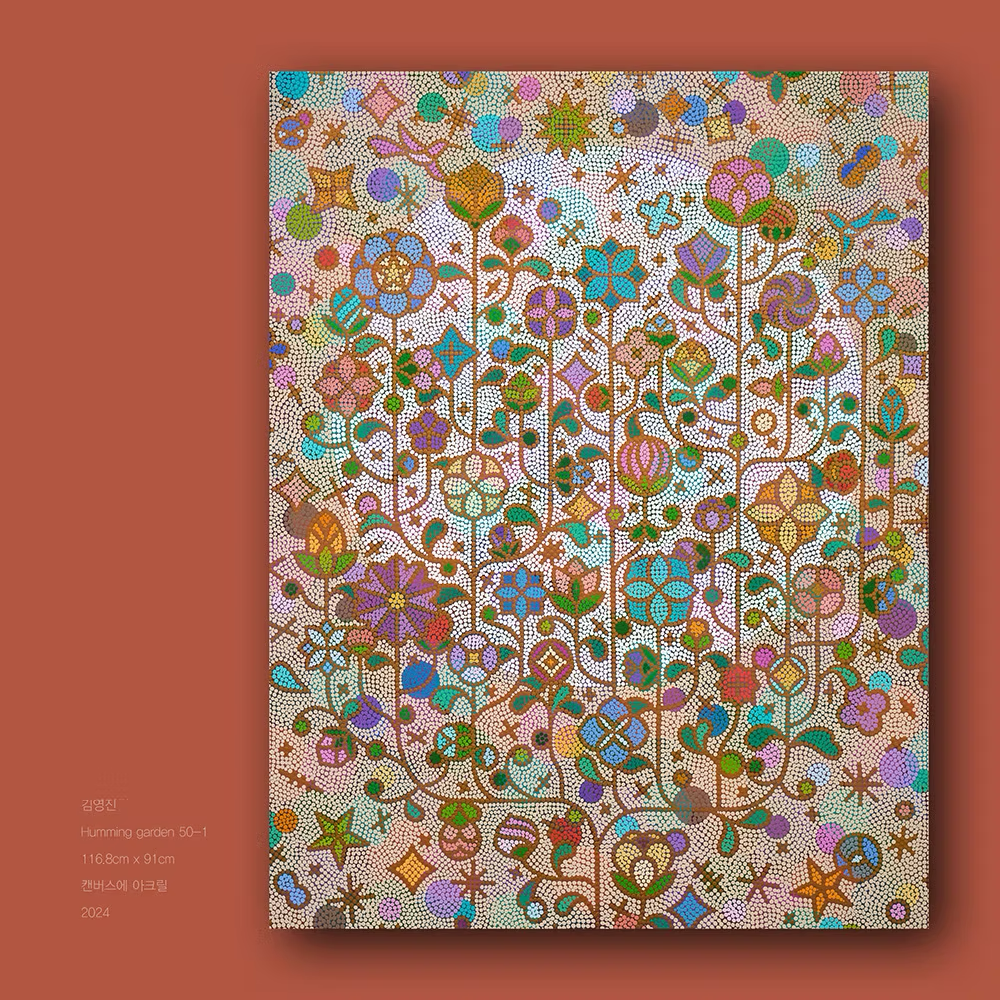
For the viewer, the effect is similarly hypnotic. Standing before one of Kim’s large-scale works, each around 100 x 100 centimetres, the eye is invited to travel across the vast fields of dots, preventing the rapid, shallow scanning we use for digital screens. This slow looking regulates the nervous system, lowering cortisol levels and fostering a sense of calm. In this way, Kim’s art functions as a visual antidote to digital fatigue. It reminds us that clarity does not come from processing more information, but from narrowing our focus to a single, manageable point.
Kim Young-jin’s work champions the importance of mental well-being in a fast-paced society. It challenges the glorification of multitasking and speed, advocating instead for the restorative power of focus and slowness. Humming Garden proves that in the accumulation of small, mindful moments, we can find a vast and enduring peace.
To explore the meditative world of Kim Young Jin, visit his website artyoungjin.com or follow his practice on Instagram @art_youngjin.