
The Vancouver Art Gallery opened a new exhibit, We Who Have Known Tides: Indigenous Art from the Collection, on November 6, 2025, with many works from the Vancouver Art Gallery's permanent collection.
We Who Have Known Tides opens with a textile piece on its title wall: the exhibit name in bright neon lettering over fabric naturally dyed with ice, described by curator Camille Georgeson-Usher as looking like a collection of tree stumps set as the background to bright neon letters. It looks equally like the rounded ripples you get when dropping a stone in clear and still water. Either way, it evokes a rooted, playful, and contemplative moment: feelings captured in all the works presented here and in all the rooms where they find their temporary home.
Georgeson-Usher emphasises how much of the work she has compiled feels poetic to her, and how much the exhibit as a work in itself, is one of poetic exploration about artists from indigenous peoples who are from coastal nations, such as Sḵwx̱wú7mesh (Squawish), səlil̓wətaʔɬ (Tsleil-Waututh) and xʷməθkʷəy̓əm (Musqueam) nations, to name a small number of Indigenous nations that exist on the West Coast. According to the British Columbia Assembly of First Nations, there are 198 Nations present in the province, and ten Nations between North Vancouver and Abbotsford, BC, in particular. The city of Vancouver is situated on the unceded, ancestral territories of the Squamish, Musqueam, and Tsleil-Waututh. We Who Have Known Tides' emphasis on showcasing artists across different North American and coastal Indigenous communities upholds the UN Sustainable Development Goals of Life on Land and Reduced Inequalities.
Each room of the exhibit, which spans approximately half of the second floor of the Vancouver Art Gallery, emboldens the artwork on display with poetic lines, capturing the sentiment Georgeson-Usher is attempting to evoke. The artists included in the exhibition are from nations across the Pacific coast, from California to artist Nicholas Galanin, from the Sitka tribe of Alaska, of Tlingit and Unangax descent, and from artist Susan Point, of Coast Salish and Musqueam descent.
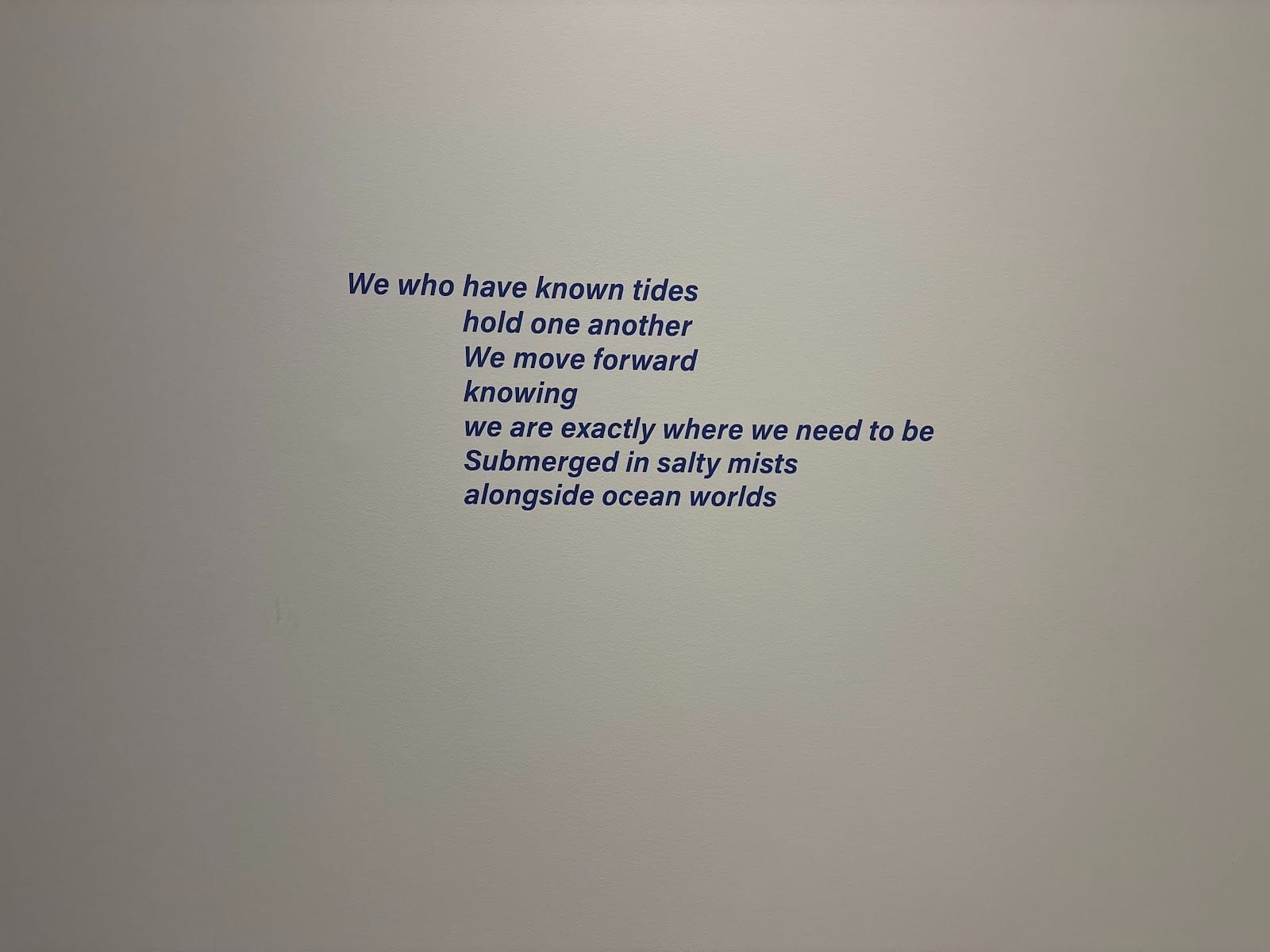
We Who Have Known Tides is divided into five rooms, including a title wall with a piece by Quebecois and Haida artist Raymond Boisjoly, an artist continuing his tendency to engage with words, theory and imagery with the text-based and textile piece at the beginning of the exhibit, and one smaller but fairly identical work at the end.
Each room begins with poetic lines situating the tone of the pieces present in the space, including approximately forty works created from the 1960s to 2025, from a variety of Indigenous artists, many from coastal communities.
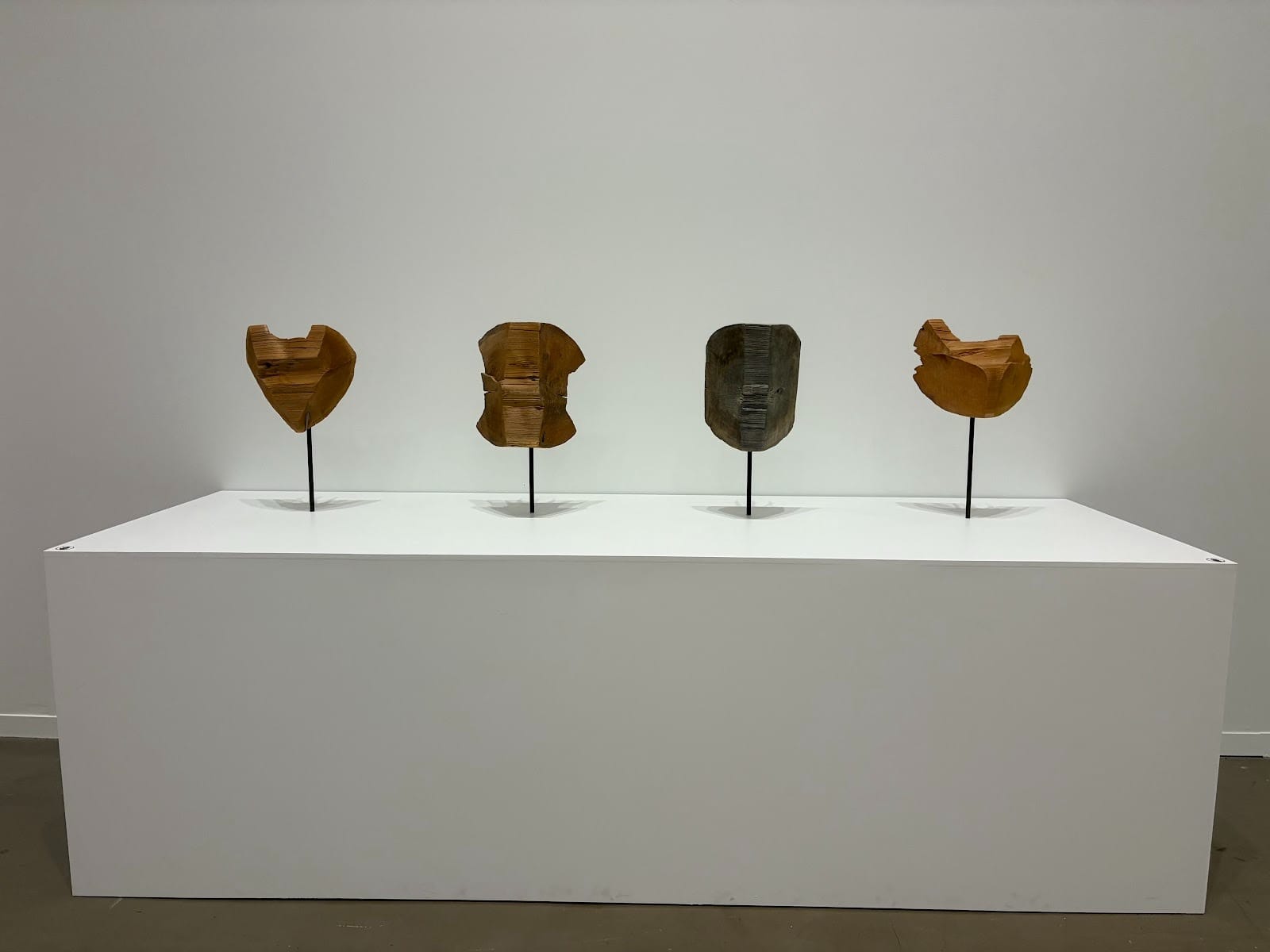
The pieces in the collection range from masks and sculptural work to textiles, film and prints made from a variety of media. In the second room of the exhibit, alongside video installation Quiver (2025), two hanging textile pieces from Qwasen, Debra Sparrow, and Robin Sparrow, are a collection of masks. This mask work is from artist Sonny Assu, titled Other sculptural pieces. In this exhibit are mask-like wood forms: Longing #23, #24, #25, and #28. Assu uses offcut cedar that he collected from developers in his reserve, the We Wai Kai Nation. He describes the “poetic beauty” of taking these woodcuts that resemble faces or masks from his community and displaying them in a gallery setting.
The physically longest single installation throughout We Who Have Known Tides, and a standout work featured on the exhibit webpage and promotional material, is Undersea Kingdom (2017) from Kwakwaka’wakw artist and activist Beau Dick. Dick’s constructions, a centrepiece of the room and the exhibit, comprise 17 carved and painted masks of varying sizes, intended to be worn in a Kwakwaka’wakw winter ceremony, and tell the story of supernatural beings in an undersea world. Beau Dick is a hereditary chief, and often features supernatural figures of Kwakwaka’wakw cosmology in his art. The Kwakwaka’wakw people comprise eighteen tribes, stretching from northern Vancouver Island to the middle of the island.
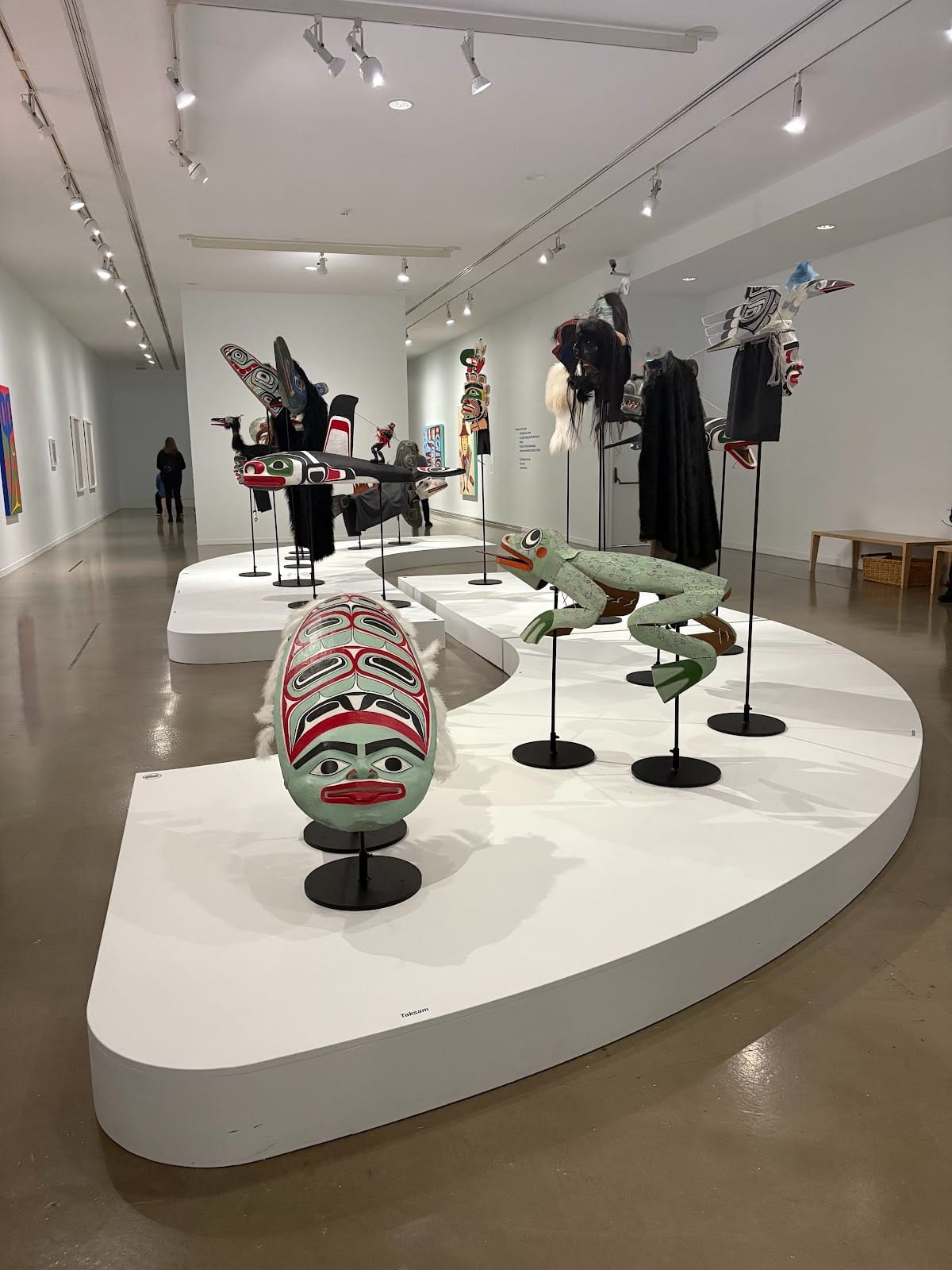
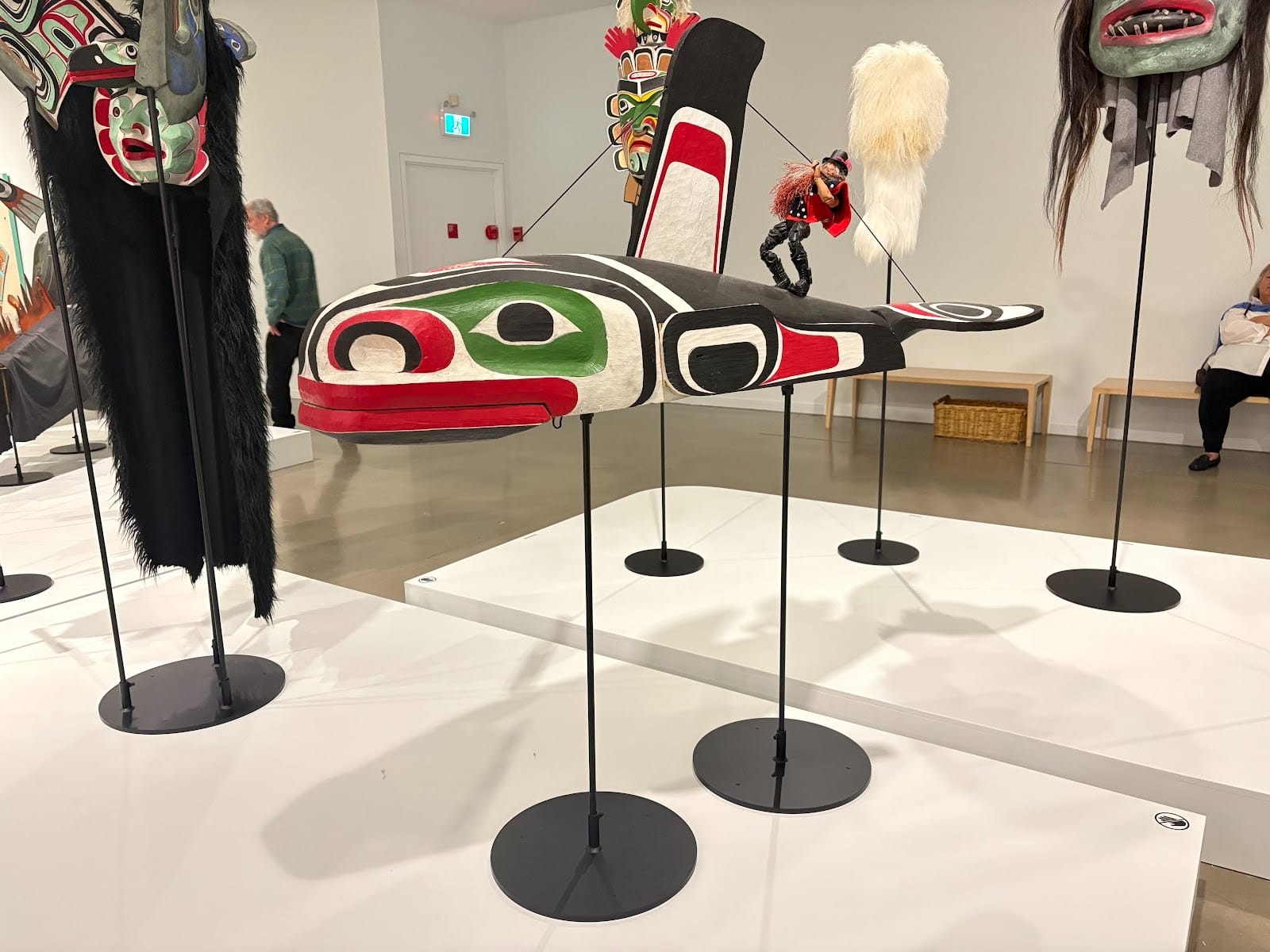
Undersea Kingdom by Beau Dick. Photos taken by Meg Collins, January 12 2026.
The room just before Undersea Kingdom includes standout works in the collection, such as the video installation by Nicholas Galanin k’idéin yéi jeené (You’re doing such a good job) 2021, and Skeena Reece’s Raven on the Colonial Fleet, 2010, which presents the regalia of a powerful “woman warrior figure,” using the garment to reference coastal stories. Curator Georgeson-Usher calls this series very energetic, “it is telling you a story. The undersea kingdom is a ceremony that’s often done in the wintertime.”
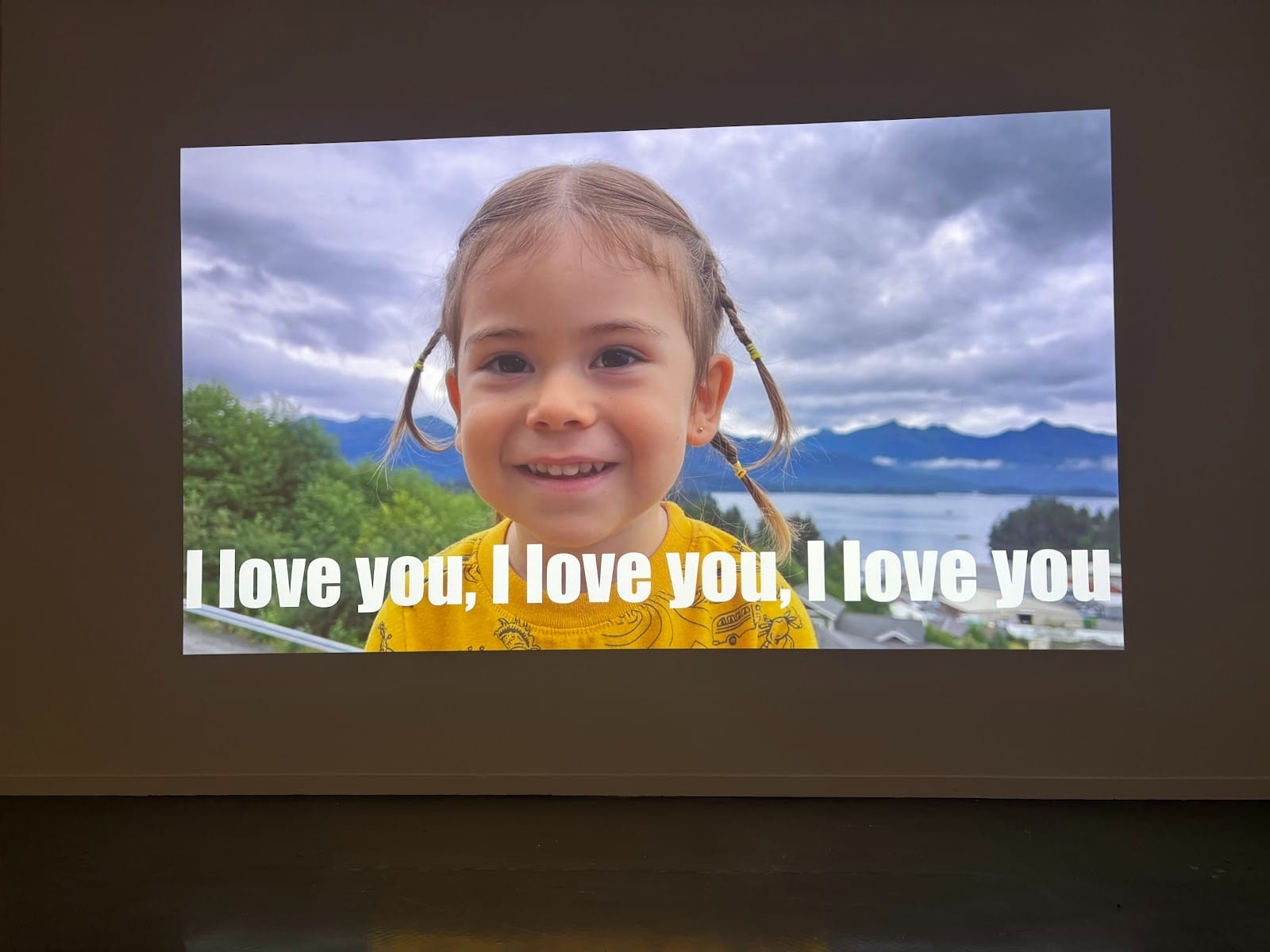
The video installation, Nicholas Galanin’s k’idéin yéi jeené (You’re doing such a good job), is a two-minute-long video showing an interaction between the Tlingit/Unangax artist and his son, where he gives his son repeated verbal affirmations, spoken to his son in Tlingit. Galanin actually, in the process of making this video, taught himself to speak Tlingit in order to pass on love to his son. He describes this as a work of family care, confronting generational trauma in his and other Indigenous communities, “our families continue to love and care for our children’s needs [...] Despite the forced removal of our languages from generations of children, and the attempts by settler-colonial states to remove and destroy access and belonging to our cultures and land, we continue to exist, to connect and reconnect.”
There are over 60 Indigenous language dialects, according to the Assembly of First Nations, as of December 2025. All of these languages, except for Inuktitut, are critically endangered. But works and movements like that of Galanin’s recorded conversation with his son bring joyfulness to language learning. It is not only about preserving, but about feeling love in Tlingit, as Galanin can be heard saying again and again, “I love you, I love you, I love you.”
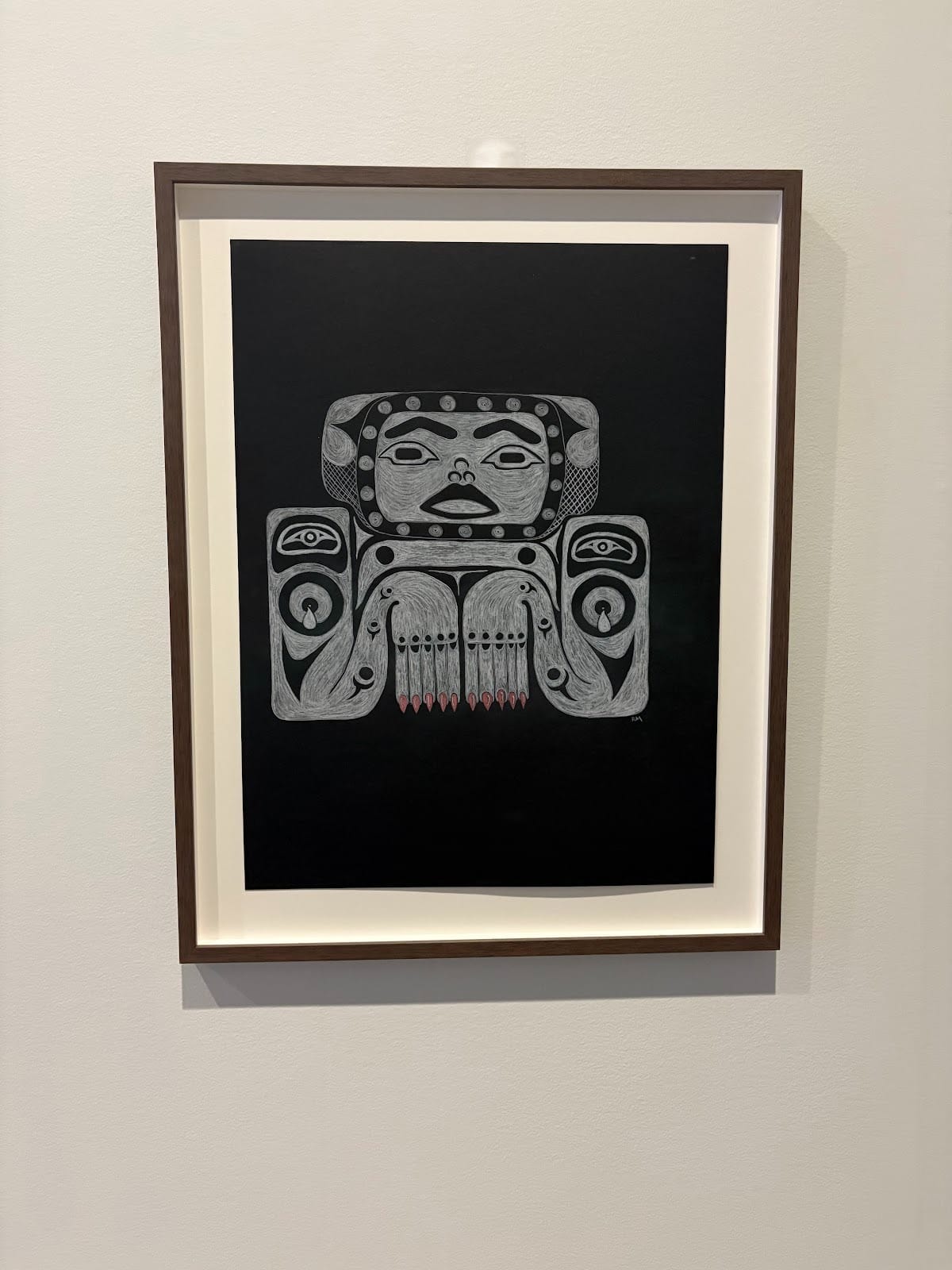
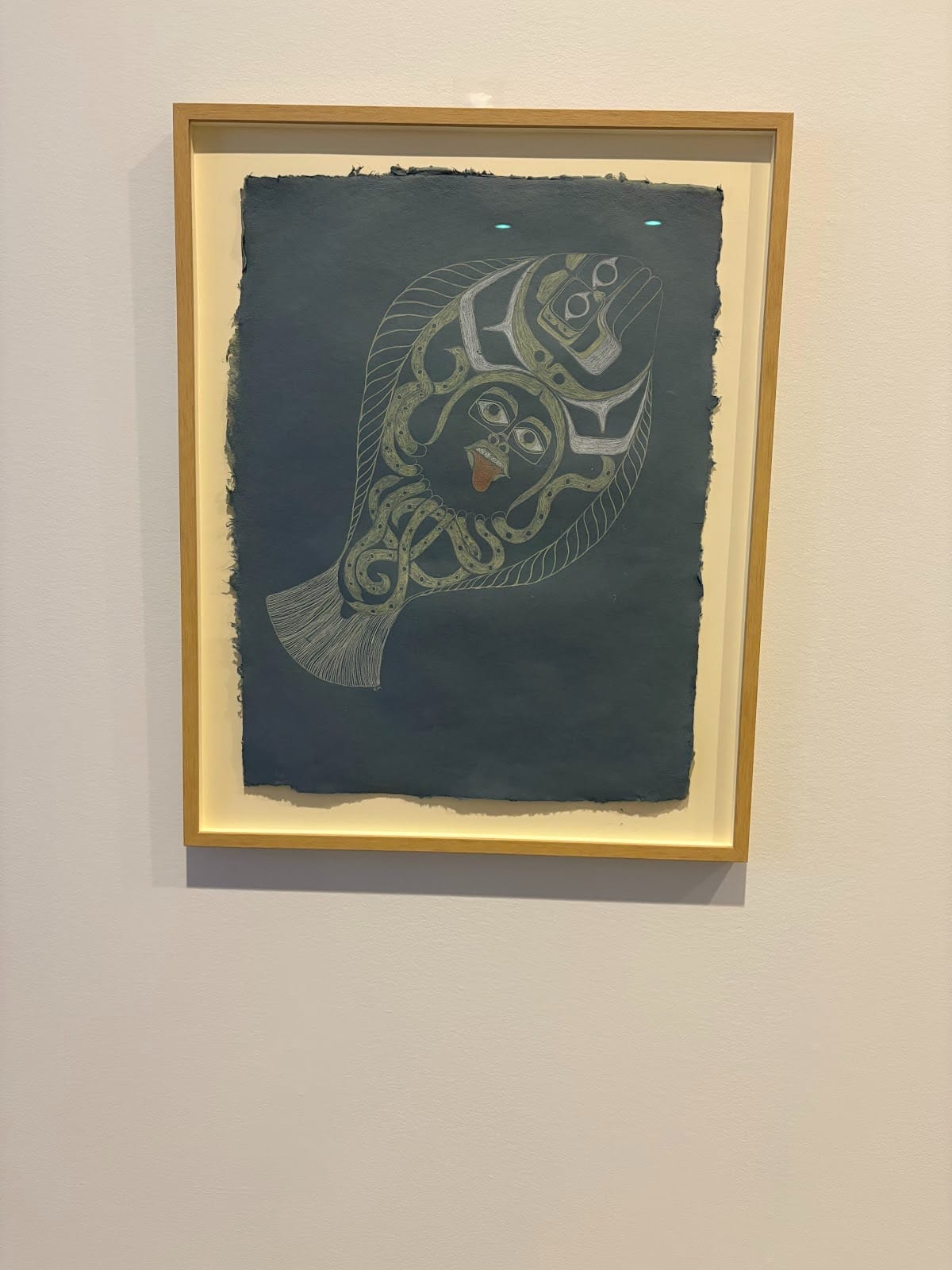
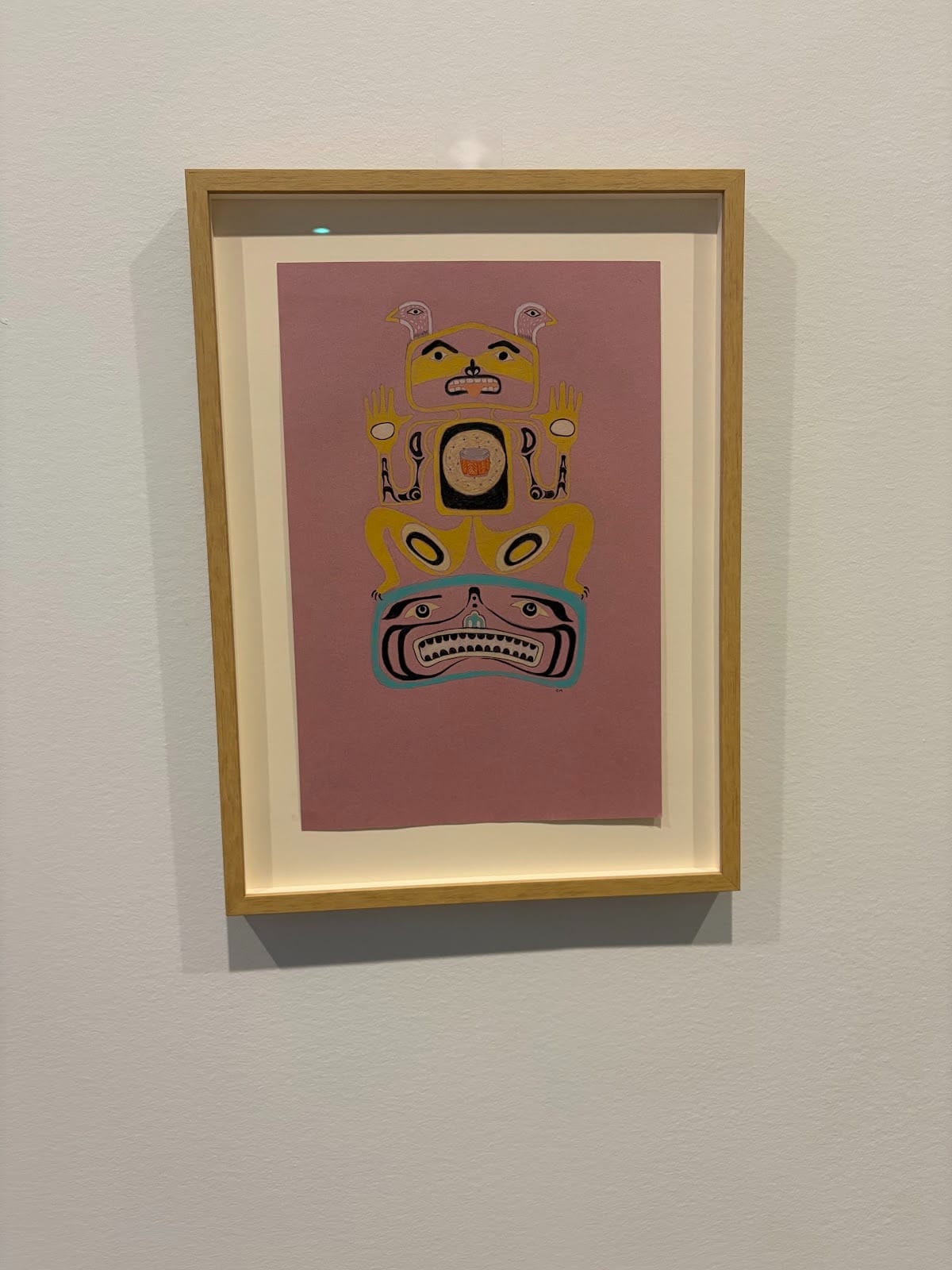
Rachel Martin left to right: Secret Menu (2022), Smoked Wild Salmon on a Goddamn Cracker Heart (2021), Our Mother Her Mother Her Mothers Mother (2022). Photos taken by Meg Collins, January 12 2026.
The exhibit follows several more pieces, like Rachel Martin’s coloured pencil pieces Secret Menu (2022), Smoked Wild Salmon on a Goodamn Cracker Heart (2021), Our Mother Her Mother Her Mothers Mother (2022), Nicholas Galanin’s monotypes, Maria Echachis Swan’s Your Power is Yours, 2019 woodblock, and Bracken Hanuse Corlett’s acrylic on plywood pieces Water Wings for Big Waves (2025) and Recording Pictographs Under Water (2025). Many of the works on display deal with community stories, like Undersea Kingdom, and the knowledge-keeping present in Corlett’s painting. Other pieces deal with language and coastal landscapes, like Sydney Frances Pascal’s Distance 2022. Overall, it is a broad range of works, each carrying with it soul, memory, family and community. It is art that cannot be divorced from communal history.
Georgeson-Usher, though feeling proud of her and the artists’ work for We Who Have Known Tides, is looking to what work still needs or needed to be done.
“I think the sore point for me is that we don’t have full coast nation representation. I’m not going to say I regret anything, but just pointing out to me the work that I need to do to bring them in.” She’s particularly hoping for more Coast Salish representation in future installations, “From here it’s figuring out how to fill those gaps, which for me is fun.”
Find out more about We Who Have Known Tides through the Vancouver Art Gallery's website. The exhibit is running from November 6, 2025, until April 6, 2026.