
In American Sign Language, the signs for “mind” and “moon” are nearly the same gesture: a tap on the temple. Christine Sun Kim built an entire exhibition out of that coincidence. Moon Mind opened at Gallery Hyundai in Seoul on August 26 and runs through October 18, 2026, marking Kim’s first solo gallery exhibition in South Korea and the first time her shaped canvas paintings have ever been shown anywhere. More than forty works, including paintings and drawings, together fill the space.
The show speaks directly to two United Nations Sustainable Development Goals: Reduced Inequalities and Quality Education. Kim, who is deaf, has spent her career treating sound and language as social structures built by and for hearing people, then making that structure visible to everyone else. Centring ASL grammar and deaf experience inside a major commercial gallery challenges exactly the kind of institutional assumption the first goal targets. By translating musical notation and sign language into a shared grammar anyone can read on sight, Kim is building the kind of new visual literacy model the second goal points toward, one that doesn’t require hearing to access.
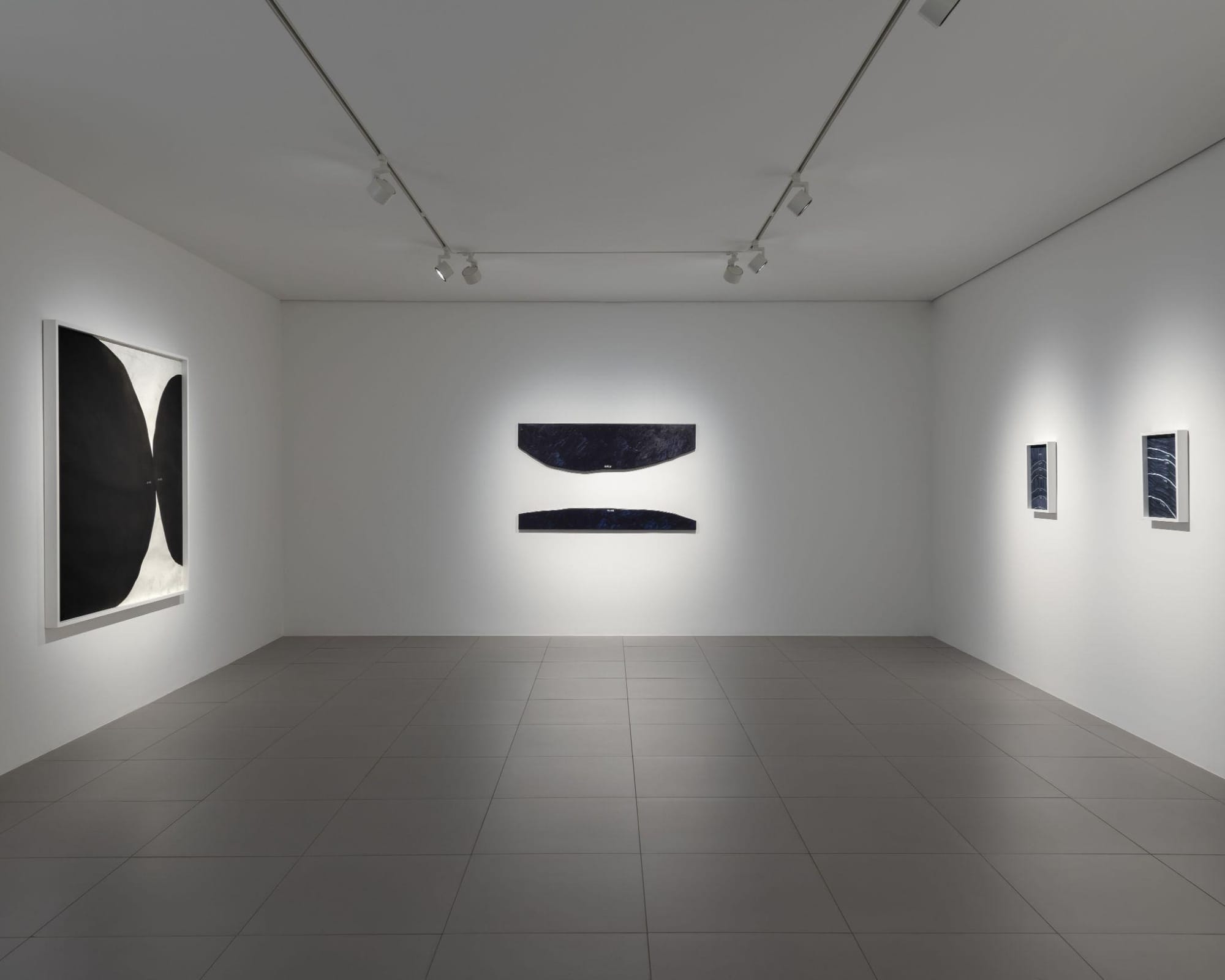
The paintings themselves work as diptychs, an upper canvas and a lower one, hung with a gap between them that changes from one installation to the next. According to Gallery Hyundai, the gap is the artwork’s real subject: one canvas stands in for the mind itself, shaped and painted as its own distinct form, while the other holds whatever the mind is reaching toward, a memory, another person, the moon, on the other, and the distance between them tracks how close or far that thing feels emotionally. In a Vogue Korea interview, Kim said the shift into sculptural, three-dimensional form was new territory for her after more than a decade of drawing. “I love the concept of my mind becoming three-dimensional and sculptural,” she said.
Kim also borrows directly from musical notation, using “p” for piano and “f” for forte, the standard marks for soft and loud, as a private vocabulary for time. In her system, p stands for the past, weighted toward family, home and roots; the more p’s stack up, the heavier that pull becomes. F stands for the future: speed, energy, and the anxiety of not knowing what’s coming. Arched lines run through the work connecting the two, a rhythm Kim uses to show a mind that recedes and returns rather than moving in a straight line.
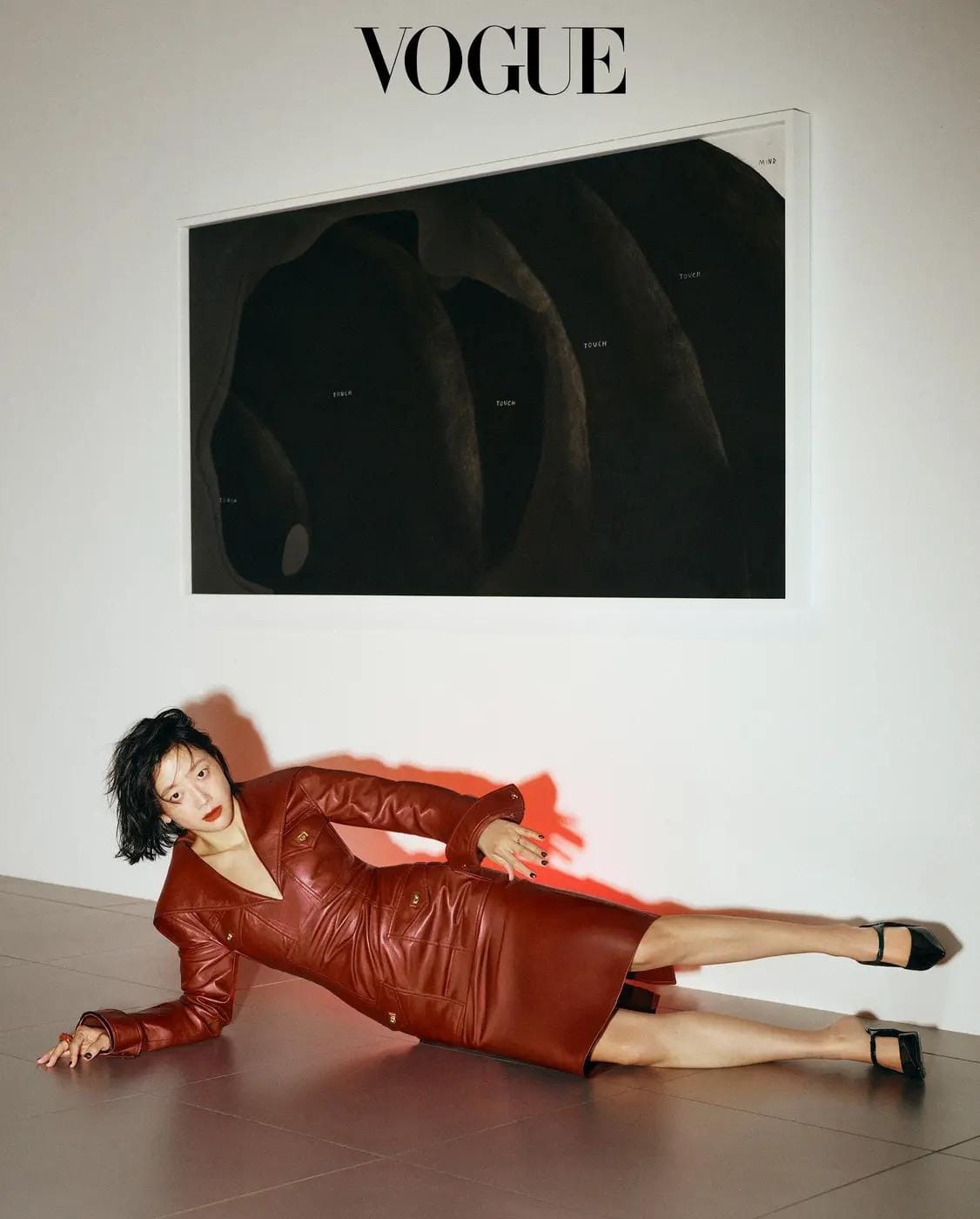
The drawings extend the same logic in a quieter register. Mind Touch Touch Touch Touch Touch (2025), a charcoal-on-paper work in the show, layers dense black charcoal across the page with the word “touch” repeated in small text at scattered points across its surface, a single word said so many times it stops reading as language and starts reading as texture. This is close to how repetition works in sign itself, where the same handshape can shift meaning depending on speed, location and how many times it repeats.
The timing of Moon Mind is not incidental. Kim opened the show weeks after a major solo survey, Have Many Dumb Fights Against Rock, at Seoul’s National Museum of Modern and Contemporary Art (MMCA), which opened July 30, 2026, and not long after wrapping years of work on a separate 13-year survey developed with the Whitney Museum in New York and the Walker Art Centre in Minneapolis. Taken together, the run marks a rare scratch where three institutions on two continents are showing Kim’s work at once, a scale of attention that, by her own account, is part of what let her risk moving from the sharp clarity of her earlier practice into something more ambiguous.
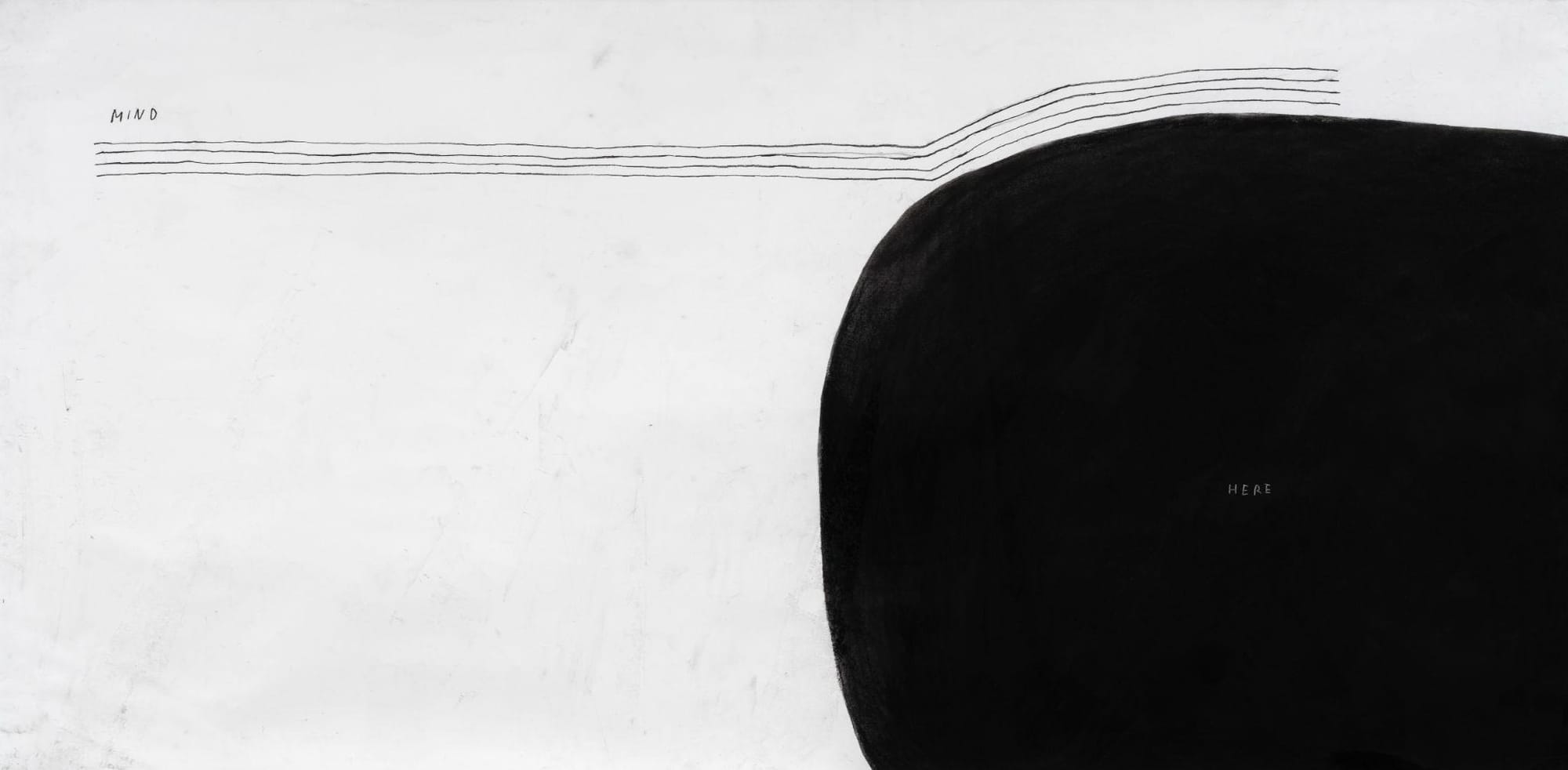
Kim’s daughter is named Dal, the Korean word for moon, and the artist has said exhibiting in Seoul connects her back to grandparents who emigrated to the United States, a throughline she’s described as a way of honouring her Korean heritage while setting an example for her own kids. Where earlier bodies of work leaned on black and white and explicit text, precise on purpose, since, as Kim has put it, she didn’t have “the luxury of being misunderstood.” Moon Mind pushes toward abstraction instead: deep blues and greens built up in swirling brushwork, dark enough to read as black until a viewer stays with them.
Taking a step into abstraction is a real risk for an artist whose earlier career was built on clarity as a form of self-protection. Moon Mind exemplifies how, after years of explaining herself in language a hearing-majority audience could not misread, Kim has earned the right to be occasionally, deliberately, beautifully unclear.
Moon Mind is on view at Gallery Hyundai, Hyundai Hwarang, 8 Samcheong-ro, Jongno-gu, Seoul, from August 26 to October 18, 2026. Admission is free.