
At House of Woonkyung in Seoul, a wooden staircase climbs from the inner courtyard, passes directly over the main hall, and descends into the backyard. Nearby in the courtyard, a fan-shaped pit cuts into the terrain, lowering visitors so they must look upward at the surrounding architecture. Both are part of A House, Arrived Again, a solo exhibition by Seoul-based artist Donghee Kim that opened September 2 and runs through October 31, 2026.
House of Woonkyung is a hanok, a traditional Korean house, built in the 1930s and known to occupy the former site of a palace. From 1953, it was the home of politician Lee Jae-hyung (1914 to 1992), and since 1993, it has been preserved as a historical site that is gradually becoming a venue for contemporary art, K-ARTNOW reports. Kim’s show includes 16 works; 14 of them are new, and it opened the same day as Frieze Seoul, an art fair held at Coex in southern Seoul. Kim, born in 1986, won the Porsche Frontier Award in the Visual Arts category at the 2nd Seoul Art Awards for his 2023 solo exhibition Hall 2.
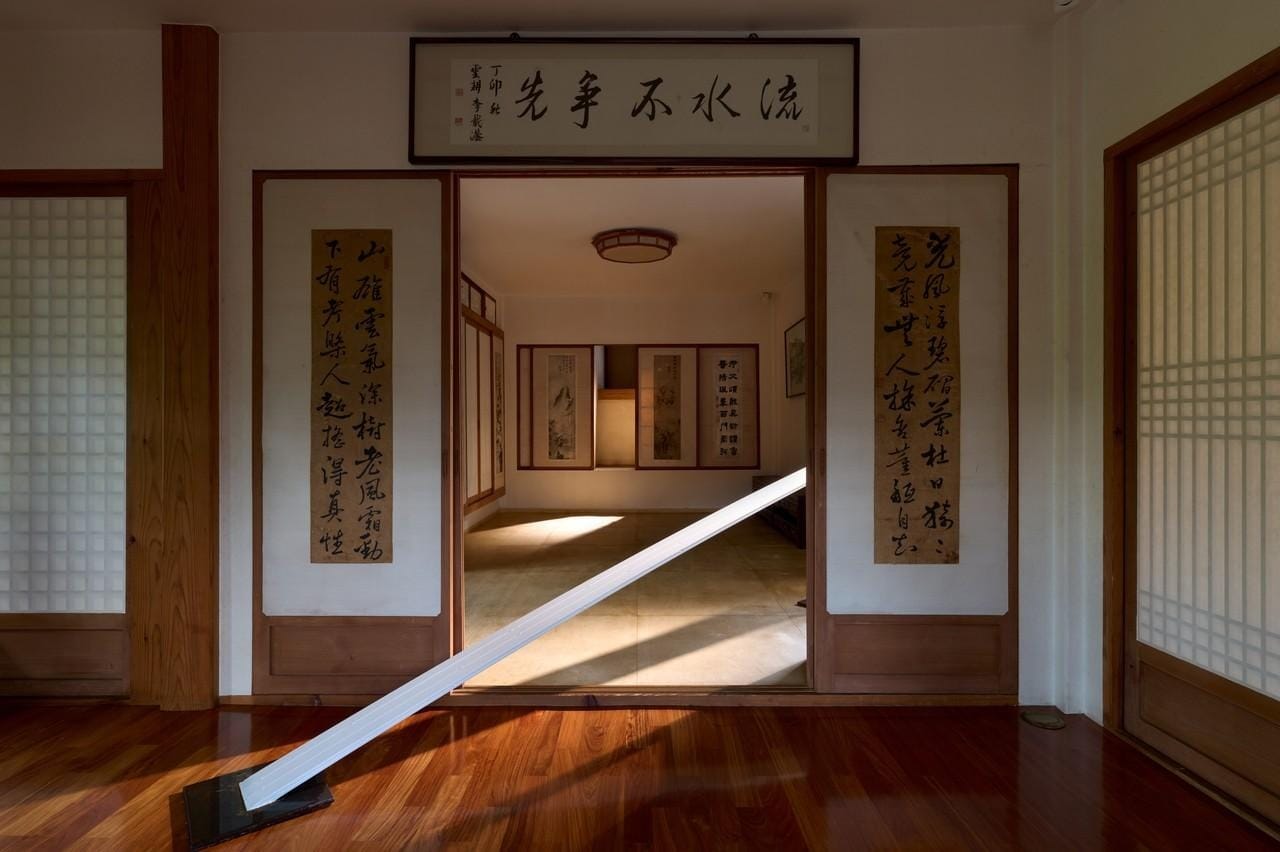
The show speaks to two United Nations Sustainable Development Goals: Industry, Innovation and Infrastructure and Sustainable Cities and Communities. In addition to his personal practice, Kim directs PROP SEOUL, an initiative that designs spatial installations, performance environments, and interactive programming. Rather than treating historic sites as fixed historical monuments, Kim designs functional physical conditions that allow heritage venues to be actively re-inhabited. Adding and overlaying structures in a historic house is a form of innovation in how existing cultural infrastructure works, which is the first goal’s territory. The second goal’s focus on protecting cultural heritage applies too, since the house is a preserved historical site now open to contemporary art.
K-ARTIST says stairs, excavated terrain, lines, an attic, maps, and sound all shift where viewers stand and how they look, bringing several spaces and times together inside the house. Its list of Kim’s work includes Reserved Darak and White Line (both 2026). Darak is the Korean word for a loft, the space inside a sloping roof where things are sometimes stored. Separately, the Korea JoongAng Daily reports that the attic of the house’s sarangchae, a section of a hanok reserved for guests, has been rebuilt at full scale, flipped left to right and set outside as a structure visitors can climb into and look back from.
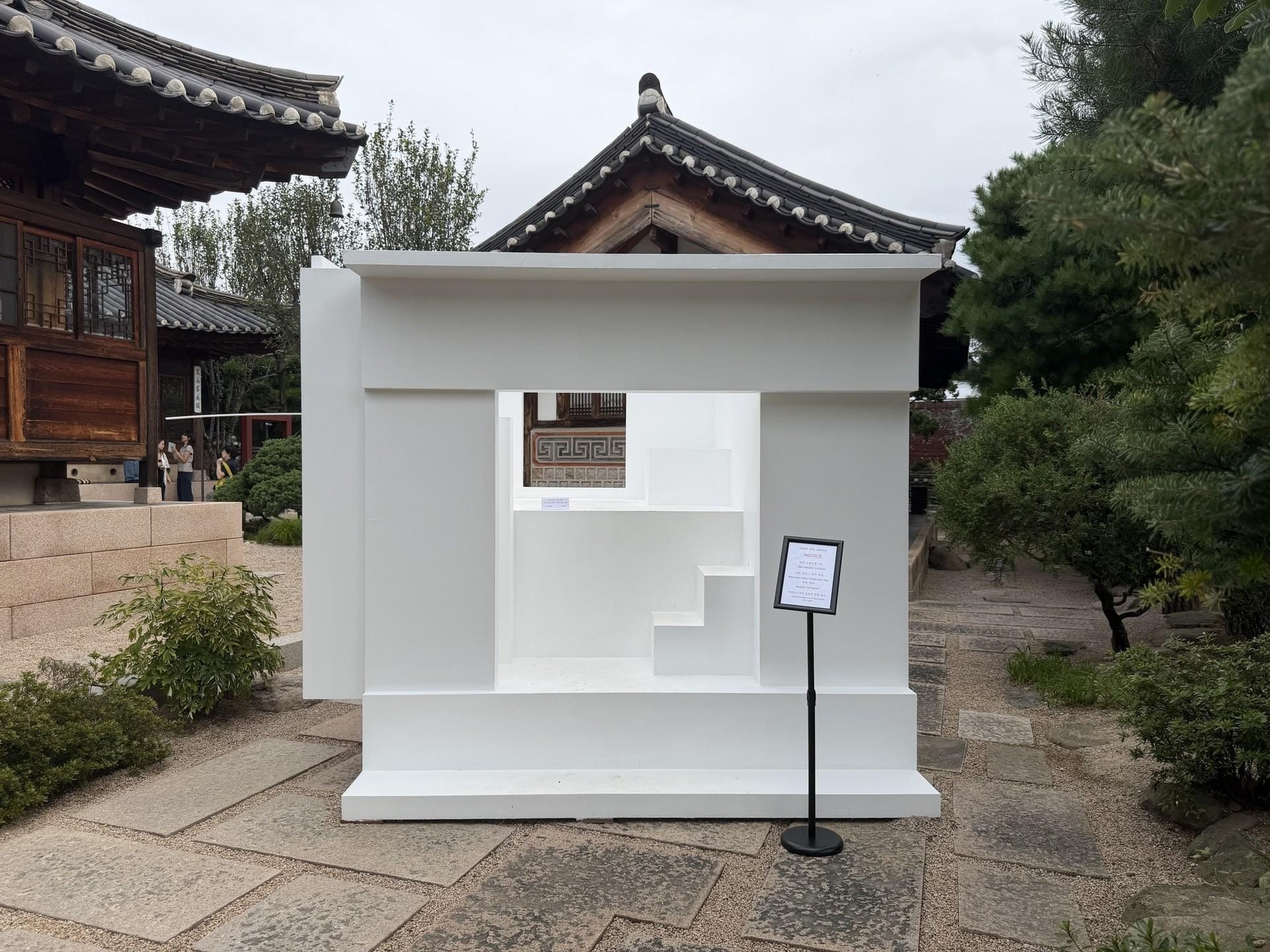
Adding structures to a hanok is familiar ground for Kim. In 2017 at Audio Visual Pavilion, a hanok converted into an exhibition venue in Seoul, he added walls, stairs, balconies, mirrors, passageways, and window frames so viewers could walk, pause, climb, and look through the space. He layered the new structures over the existing building rather than erasing it, and the same article states that he simulates viewers’ routes and sightlines before construction begins. “Through the structures, I consider how viewers move through the space,” Kim explained in a 2020 interview with Yeji Kim at AVP Lab, in an English translation on their website.
Seeing the show takes planning. Admission is by reservation only and costs 15,000 won, with visits limited to 80 minutes. The Woonkyung Foundation’s visitor page adds that visitors must remove their shoes inside the hanok, must be seven or older, and should take care on stairs and sloped areas. It also notes that the house’s structure makes wheelchair access difficult. The estate is located approximately 600 metres from Exit 1 of Gyeongbokung Station (Subway Line 3).
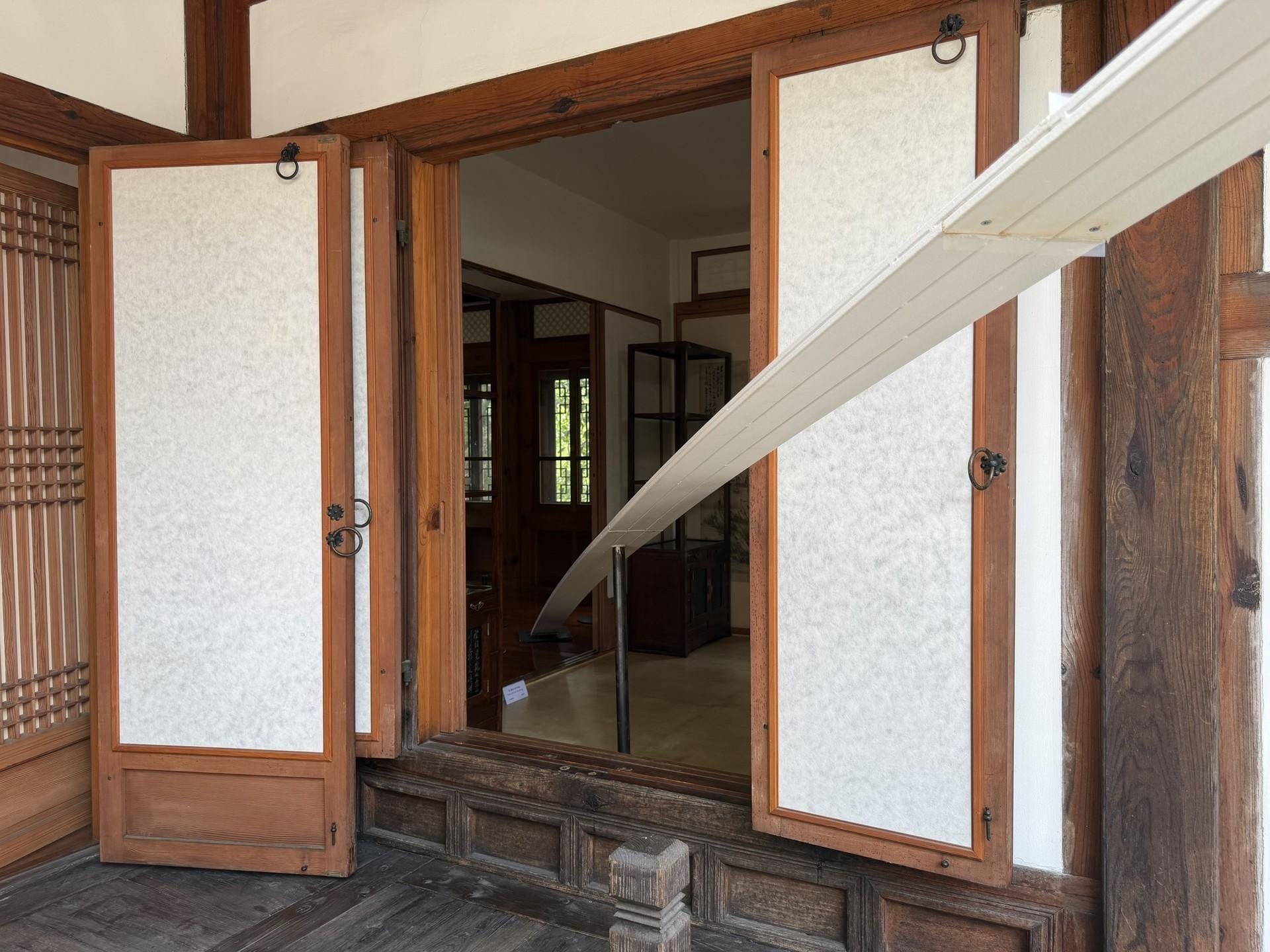
The title promises a return, and the return changes what visitors see. By reintroducing earlier structural concepts and altering circulation paths, A House, Arrived Again suggests that past forms never truly disappear; they re-emerge to meet present conditions, allowing visitors to leave the historic house with an entirely transformed perception of its space.
A House, Arrived Again is on view at House of Woonkyung, 7 Inwangsan-ro, Jongno-gu, Seoul, from September 2 through October 31, 2026. Reservations are required.