
Martine Gutierrez’s Odysseus and the Sirens, a 20-minute-long film of a performance piece at Polygon Gallery, imagines the Odyssey sirens anew. Odysseus and the Sirens is now available to be viewed online through summer 2026. Polygon Gallery and Gutierrez premiered/launched the project on Polygon’s new online-only exhibition Parallelogram. The film and performance evoke the United Nations Sustainable Development Goal of Gender Equality.
The original performance of Odysseus and the Sirens took place at The Polygon Gallery on July 11, 2024. A crowd of viewers can be seen standing and sitting around a platform, water running on it that appears like shallow waves, and rocks are spaced apart evenly to imitate the shore from which sirens, in The Odyssey, would lure sailors to their deaths. Gutierrez’s Odysseus, played by Blake Abbie, is draped in a blue sheet, descending from a rock on the far side of their makeshift stage near the audience. The actor slowly steps around the perimeter of the stage, glancing over to the rocks where the sirens lay, as one crawls in his direction. The performance is accompanied by a violin, which matches Odysseus’ movements. The sirens are shirtless, all with long black hair covering their chests, wearing long grey and white fabric wrapped around their legs, giving the impression of a tail. As Odysseus continues to walk the perimeter of the stage, two sirens follow him.
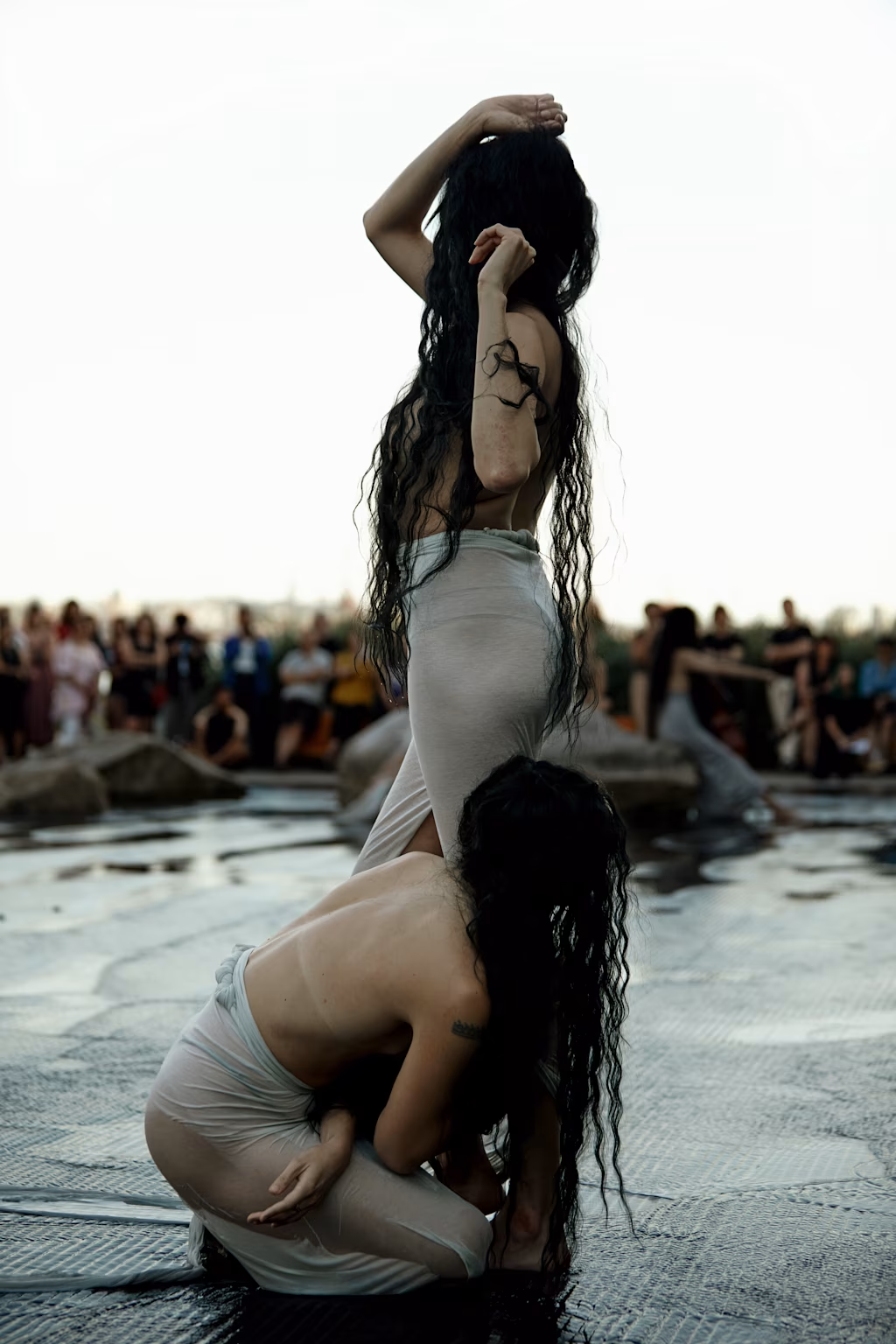
The film continues until the end with their pursuit of Odysseus, complete with Martine Gutierrez herself playing a siren. Sometimes they are grouped, arms moving around each other, and sometimes they are slowly creeping across the stage.
In The Odyssey, Odysseus commanded his crew to put wax in their ears to block out the sirens’ song, which was known to lead men to their doom, and to tie him to the ship’s mast. He committed to hearing the sirens because minor god Circe had told him to, as Emily Wilson’s translation of the passage from book 12 reads, “And [Circe] says that I alone should hear their singing.” Though after hearing their voices, he asked to be freed, Odysseus and his crew cleared the island, they removed the wax from their ears, and he was freed from his ropes.
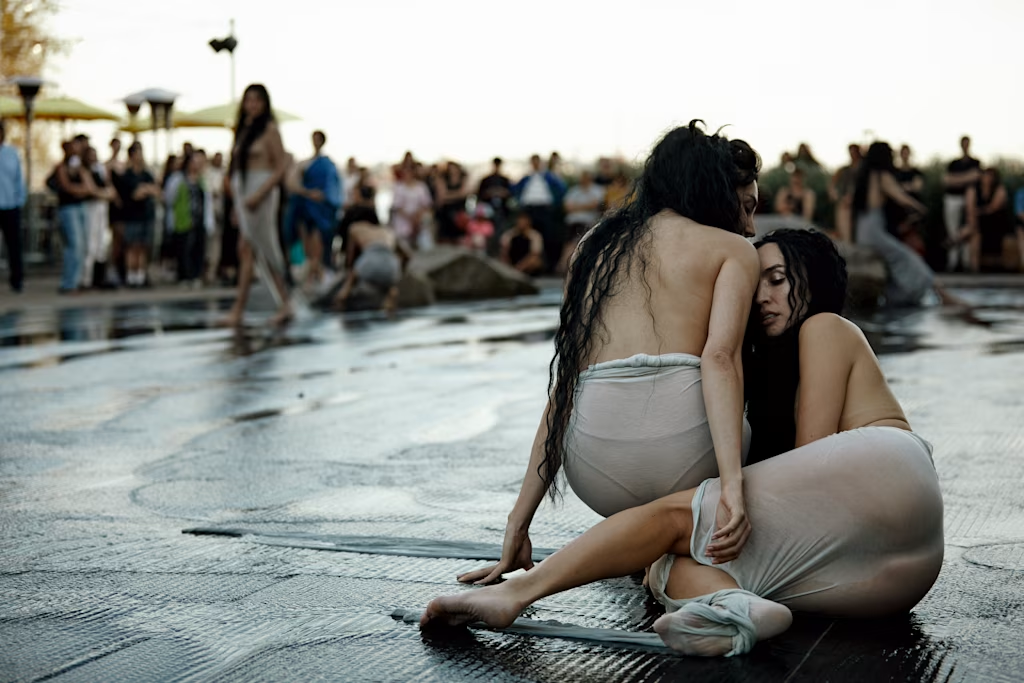
Gutierrez imagines this interaction ending differently. Ultimately, her Odysseus is seen, after catching the eye of one siren, breaking from the group, wandering off of his chosen path and into the center of the stage, to join the rest, who, grouped around him, lead him offstage. He is finally seen being brought into the gallery and up the stairs to the second floor. Gutierrez’ “troupe,” as Blake Abbie writes for SSENSE, was the term she used to describe her performers, is made up of a group of artist friends: Blake Abbie, Nash Glynn, Young Gun Lee, Bhenji Ra, Elliot Ramsey.
Without Abbie’s piece, the interpretation of this performance might lean in a very different way: perhaps this is a reflection on isolation and the need for community because an isolated Odysseus is so much more vulnerable to this threat from sirens, like many of us are vulnerable in a plethora of ways and to a plethora of things without community support. But it is through Abbie’s description of their relationship, and through quotes where Gutierrez reflects on her identity, that the piece’s significance is solidified. The performance, and subsequent short film now on display with Parallelogram, are in fact concerned with isolation and the need for community. Except the function of the siren figure is not as a threat to Odysseus' life, but instead an invitation. Gutierrez re-thinks the sirens and identifies with them. The performance is a celebration of Gutierrez’s identity as a transgender woman, of femininity generally, and it is, to borrow Abbie’s words, the creation of a new lore.

Gutierrez, in a conversation with Abbie written into the SSENSE piece, imagines mermaids, particularly the character Ursula, to be transgender figures or icons. “They’re mythologies, to be half something. It’s the perception of a woman, until a closer look.” Gutierrez does her own luring, as Abbie writes, “[s]he has the ability to at once graciously invite but also lure people into her world.” It is this idea that appears to ground Odysseus and the Sirens. The story becomes less about Odysseus, as he literally only moves around the perimeter of the stage, not allowed until the final moments, to venture to the center. It is instead about this group of feminine characters leaning into sensual expression, expressing femininity and a communal embrace without fitting neatly into an identity, without being concerned with perception. They exist amongst themselves; they accept this man into their group—they are simply sirens.