
Starting early July, an exhibit of Greg Girard’s career’s work will be on display at North Vancouver, British Columbia’s Polygon Gallery. The exhibit’s opening night will be on Thursday, July 9, at 7:00 pm. Greg Girard is a Canadian photographer whose photos have appeared in TIME, Newsweek, and National Geographic, alongside other publications.
The upcoming exhibition is to showcase a career spanning five decades, with work from the mid-1970s to 2026 commemorated in a new book, Greg Girard: Photographs 1972-2026. His work considers social change, going from photographing the Downtown Eastside of Vancouver as a teenager in the 1970s and early 1980s to photographing the Walled City of Kowloon in Hong Kong with photographer Ian Lambot. Girard’s work represents the United Nations Sustainable Development Goal of Peace, Justice, and Strong Institutions through its reflection on social change and socio-economic disparities over the past few decades but also through its demonstration of extractive photography.
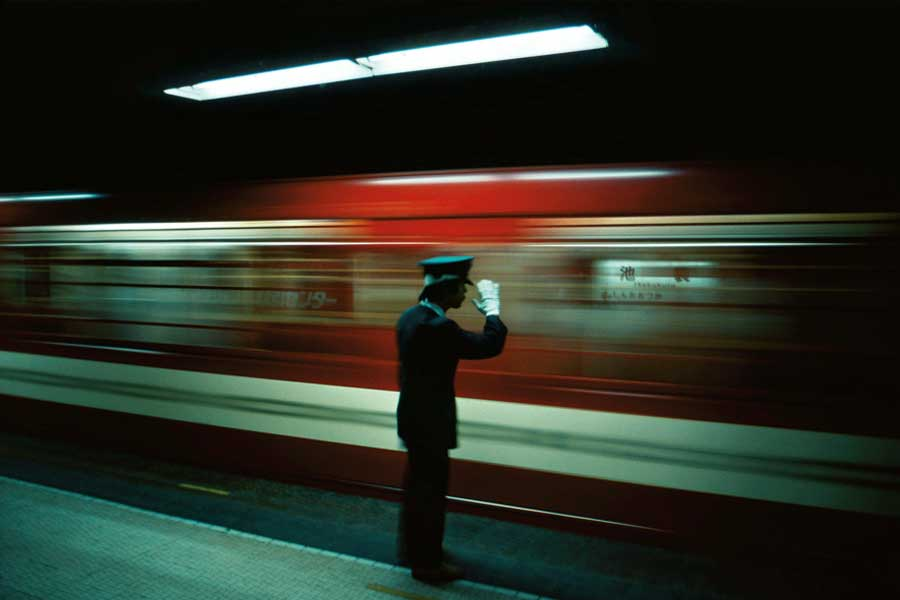
Girard’s photos evoke a sense of motion, centering humanity in the frame. People are the center of his work, and typically, he leans toward urban landscapes. As for his early work in Vancouver, it feels more intimate.
But through Girard’s intention to be a photographer reflecting the world outward, his work carries with it a great deal of distance. This could be influenced by his career as a professional outsider, capturing and profiting off of his subjects’ lives. When Girard photographed the Downtown Eastside in the 1970s, he was a teenager from the Burnaby suburbs. When Girard photographed the Walled City of Kowloon, he was a foreigner inspired by a photograph of the Hong Kong harbour by an American photographer, also an outsider. In an interview with Montecristo, he described this moment: “I sensed that whatever that picture had in it, I wanted to do that. I decided to go to Hong Kong.”
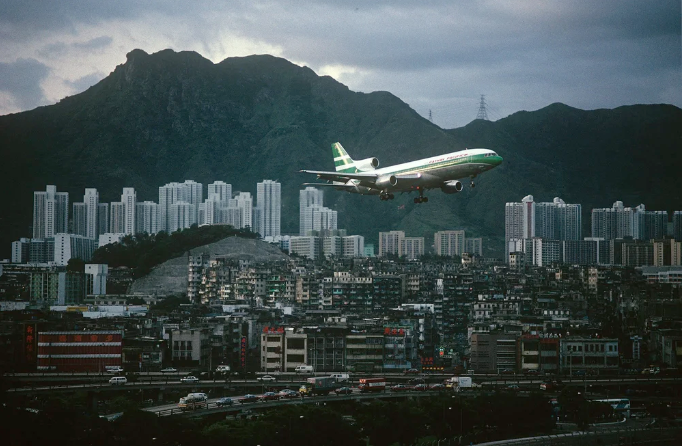
His work in Hong Kong resulted in two books published with Ian Lambot, City of Darkness: Life in Kowloon City (1993) and City of Darkness Revisited (2014), which even influenced Christopher Nolan.
The Kowloon Walled City, one of the most densely populated places in the world, began as a military fort. In 1898, China gave Great Britain control of Hong Kong, Kowloon, and other territories through a land lease, though as years passed, the fort was abandoned. Elizabeth Sinn, in her 1987 essay “Kowloon Walled City: Its Origins and Early History," writes of this grey area of possession, “[u]ntil recently, it was a place over which two governments claimed jurisdiction but with neither actively administering it.” Its “peak” in the 1990s, according to an article by 99 Percent Invisible, had a population of 33,000 people in the 6.5 acres making up the City. Kowloon Walled City was later torn down in 1993.
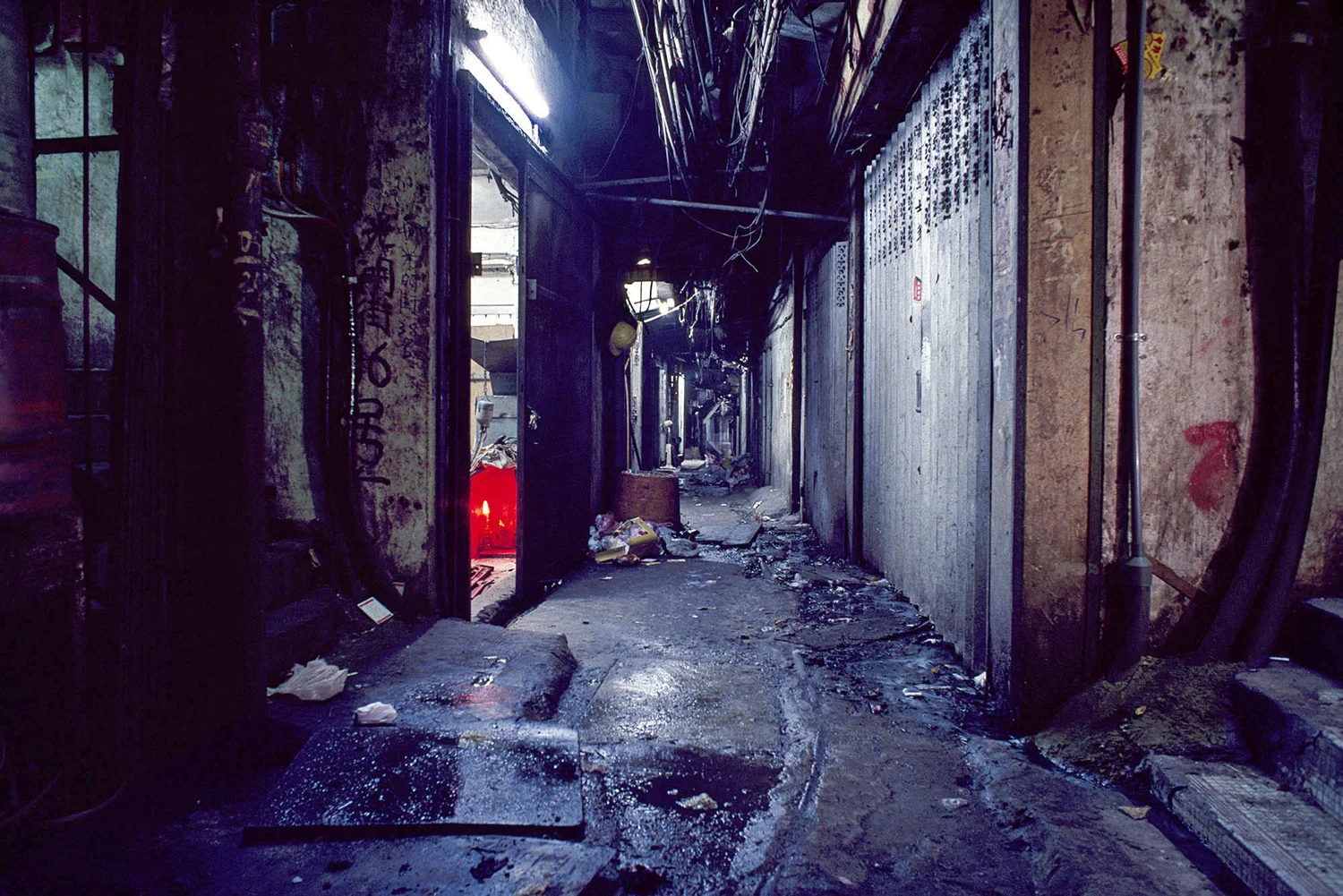
“Being a spectator of calamities taking place in another country is a quintessential modern experience, the cumulative offering by more than a century and a half’s worth of those professional, specialized tourists known as journalists,” Susan Sontag writes in Regarding the Pain of Others. Girard’s work is beautiful and informative, focusing on lesser-known areas and lives, but it also very much reminds me of this quote. His work is much more than his book City of Darkness, but it is worth acknowledging the impact that City of Darkness had on his career.