
Neeraj Ghaywan’s Juice is a celebrated Hindi short film that, in less than fifteen minutes, illuminates the unsaid internal hierarchies of a middle-class Indian home.
Produced and released in 2017, the Indian director’s film begins with what seems like a run-of-the-mill dinner featuring an elaborate home-cooked meal, drinks, and a myriad of guests. The premise is simple: Brijesh Singh has invited several coworkers over (unsurprisingly all men), and their wives follow in tow. As per convention, the women, after greeting the gathering, politely and unceremoniously make their way into the kitchen to help the hostess, Brijesh’s wife Manju. Originating from this very obvious demarcation of the two domestic spaces, the film comments on the superimposed inequalities that exist within the home while also exposing the brittle, ironic ideologies that uphold them.
The film is a sharp, quick critique of unequal gender and class structures, as well as a tale of quiet resistance. For this reason, it is relevant to the United Nations Sustainable Development Goals of Gender Equality and Reduced Inequalities.
Actress Shefali Shah plays the industrious hostess Manju, Brijesh Singh’s wife, who acts as the audience’s lens for almost the entirety of the film. As her husband and his coworkers banter and bicker about the new female superior at their workplace and her rigidity, Manju is seen cleaning up after their appetisers. The men meander through several topics of conversation, spanning everything from workplace politics to the Mughal empire and Trump’s capacity to really make America great again. Their wives are not around to contribute, defend, or offer perspective. Manju, who is sometimes present, is never considered part of the conversation.
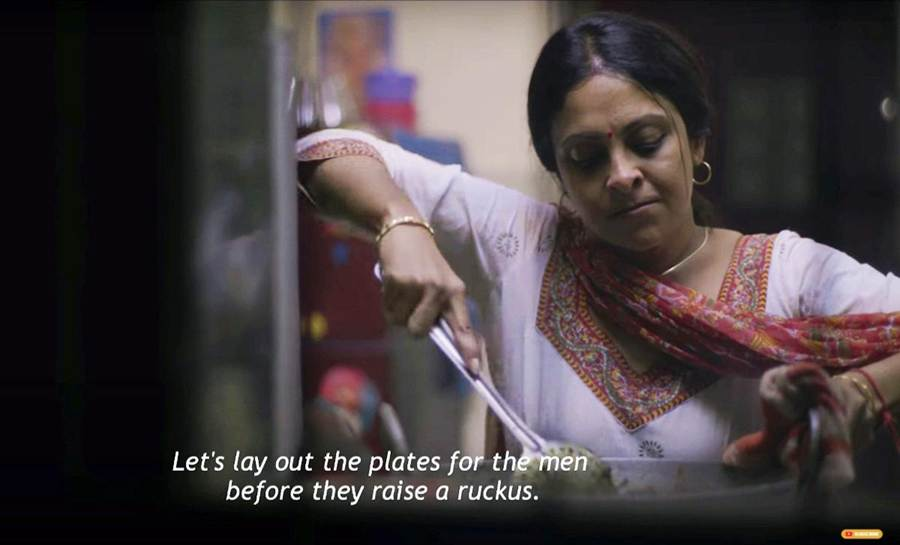
The film highlights domestic female labour in several shades and stages. When talking about their female superior, one guest argues that because of the physiological differences between men and women and the demanding nature of their job, her appointment was ill-fitted and wrong. This discussion is juxtaposed with a scene of Manju ironically taking on all the physically taxing duties of hosting: filling the water cooler in the heat, cleaning up after her guests, and working in the kitchen, while her husband and his friends remain seated.
While inferior in agency to their husbands, the women perform in accordance with a sense of internal hierarchy in the kitchen. Busy and as hot as a furnace, the space is populated exclusively by women: counterparts to the guests outside and the housemaid, Parbatiya. The ancient fan here doesn’t work, and Manju’s husband couldn’t be bothered to help get it running. The conversation amongst the women involves concerns around one of the wives choosing not to have a child. They encourage another, Rajni, to leave her job because of her pregnancy. The discourse is imbued with a general resigned sense of sacrifice for the sake of convention, because their lives must be organised to serve an existing structure. Their conversation is more rooted in reality than anything the men are talking about outside, because the decisions they make have actual consequences to their families. It is ironic, thus, that the wives are confined to the kitchen. The film here highlights that while the machine of patriarchy in an Indian home is invented by men, its engines are kept warm by the mental, emotional, and physical labour of the women.
Parbatiya, the house-help, is relegated to a different kind of subjugation within this space. In a moment that is heavy with unspoken convention, she is given a common steel glass to drink tea out of, as opposed to the ceramic cups reserved for guests. Parbatiya feels othered and takes her leave as a result. Power is exerted in all layers, trickling down from the top.
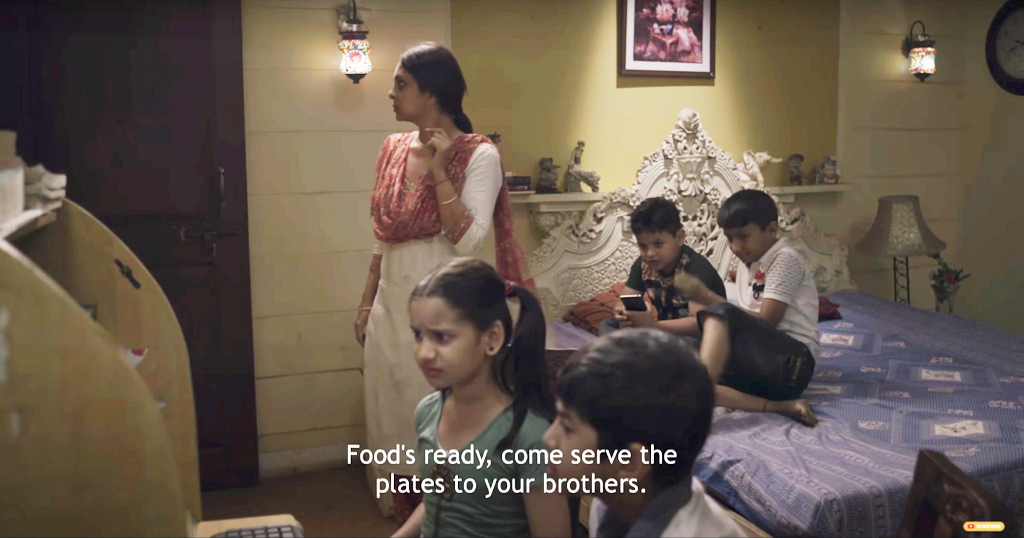
Manju, while participating in the chaos, is also an active observer of it. We learn that she had to give up her career to raise her children, but she doesn’t believe that everyone should follow in her footsteps. She notices how Dolly, the only female child at the gathering, is chastised by her mother meaninglessly for the same behaviours as the boys, while the boys experience no recourse. Dolly is also asked to feed her brothers before getting any food for herself. Patterns around subjugation begin at a young age, and Manju finds herself upset by the realization.
The pivotal moment of the film arrives at the very end, when Manju, wrestling with a serving of burnt chicken, gets called by her husband to “hurry up." She stops everything she’s doing, pours herself a glass of cold orange juice, pulls up a chair to where the male guests and the soothing watercooler are, and sits down with them. The literal and figurative symbolism of pulling up a chair at a table full of entitled men is powerful, earned, and well-executed. The pause that punctuates her departure from the designated female space of the kitchen to that of the living room is palpable.
With this small act, Manju breaks the hierarchical spell and stuns the otherwise self-absorbed gathering of men into silence. The genius of this scene lies in the fact that this act of resistance isn’t contested. It is clear that they are an educated enough group of men, having discussed kings and world politics, to recognize the need for equality and the value of female labour. No one asks Manju to leave because the hierarchy is unspoken; some of it is even internalized. It is perpetuated by daily action and the general climate of the home. Manju is quiet, hurt, and visibly exhausted by the events of the evening. The men, especially her husband Brijesh, appear embarrassed.

Aside from Shefali Shah’s powerful performance, what is most fascinating about this film is that the premise doesn’t need to be anything out of the ordinary to expertly showcase these existing dynamics. The film quietly and succinctly clarifies just how poisoned and unjust our homes can be by default and probes us to investigate if the way we show up in our domestic spaces reflects that injustice.