
A new installation at the Vancouver Art Gallery running from May to November 2026 celebrates British Columbia’s remaining ancient forests, some of the oldest trees in the world.
SANCTUARY upholds the United Nations Sustainable Development Goal of Life on Land and Climate Action by bringing attention to not only the beauty and ecological necessity of ancient forests, but also the great importance of cedar to the Sḵwx̱wú7mesh Úxwumixw Nation, as well as other Indigenous peoples.
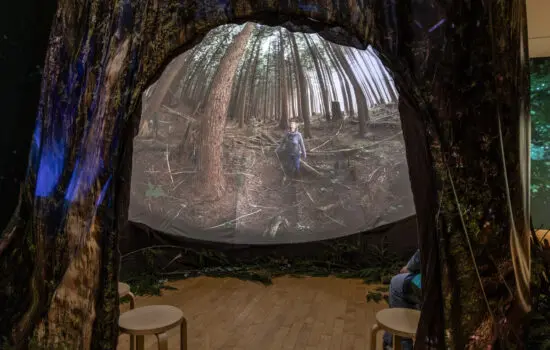
The central piece of SANCTUARY is a 360-degree experience set in some of British Columbia’s last remaining ancient forests. The Vancouver Art Gallery, on its website, describes the installation as “an adventure for the senses and an ecological awakening.” Viewers can experience the piece inside a dome in the Vancouver Art Gallery that is made to look and represent a 1,800-year-old red cedar tree.
The installation is created by Dr. T’uy’t’tanat Cease Wyss in collaboration with filmmakers Damien Gillis and Olivier Leroux.
On the floor inside the dome, there are ferns laid around the sides, evoking in viewers a feeling of being present in an old-growth forest, as the video is projected around them. Projections outside of the dome make the room that it’s in look like it has been enveloped in leaves and sunlight. The film features the Inland Temperate Rainforest in BC’s Kootenay region and the Dakota Bear Ancient Forest. The Dakota Bear Ancient Forest is known to the Sḵwx̱wú7mesh Úxwumixw (Squamish) People as Stalkaya (Home of the Sea Wolves). This forest is situated on the Sunshine Coast in the unceded territory of the Sḵwx̱wú7mesh Úxwumixw (Squamish Nation).
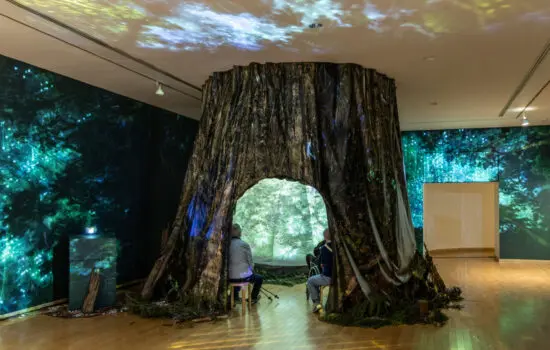
The work also features narration by Dr. Wyss and the layered sound of birds, flowing streams, and waterfalls. The work includes reference to culturally modified trees, showing the Squamish Nation’s long-term care of Stalkaya or Dakota Bear Ancient Forest.
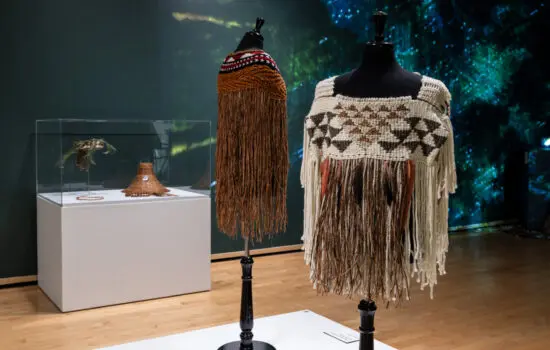
The installation is accompanied by woven pieces, including clothing and regalia, created by women of Sḵwx̱wú7mesh Úxwumixw (Squamish) Nation. The weavers, also referred to in Dr. T’uy’t’tanat Cease Wyss’ curatorial statement as “Cedar Women”, include Vera Brown-Douglas, Tracy Cameron, and Slhamexwntenaat Rachel Baker. Brown-Douglas, Camera, and Baker, though varying in experience, are all weavers who express cultural pride through their work. Cameron is a keeper of ancient styles of Squamish weaving, Brown-Douglas is a matriarch telling stories through her woven work, and Baker is an emerging weaver who creates regalia with cedar and wool.
According to the Ancient Forest Alliance (AFA), a charity that works to protect old-growth forests in British Columbia, a forest is considered to be “old-growth” because of its age. They note that old-growth is typically 250 years in wetter coastal areas or 140 years in drier regions where there’s less disturbance. These forests not only function as shelter and food sources for a variety of species, including Black bears, but also prevent erosion, filter clean water, and store massive amounts of carbon. According to maps created from BC Ministry of Forests data, 74% of the original old-growth forest on BC's southern coast has been logged.
SANCTUARY: The Ancient Forest Experience revels in British Columbia’s ancient forests and in the expansive significance of cedar, particularly for Sḵwx̱wú7mesh Úxwumixw (Squamish) people.