
Simranpreet Anand’s Living With The Eternal is an interdisciplinary body of work that draws on a Sikh perspective to understand the idea of the “eternal” as something more prismatic.
Through religious objects, we travel from commercial commentary to domestic implications. This multifaceted journey urges us to think about sustainability, masculine-focused spiritual imagery, and capitalism. This is why this exhibit is relevant to the United Nations Sustainable Development Goals of Responsible Consumption and Production, and Life on Land.
The showcase begins with a faded print of Sobha Singh’s 1969 portrait of Guru Nanak, originally contracted by the Shiromani Gurudwara Parbandhak Committee (SGPC), to mark 500 years since Guru Nanak’s birth. The exhibit contrasts this with a picture of mass-produced stock of unsold framed images of Guru Nanak in a religious goods shop. These images build on the original but are made vastly different with golden artificial detailing to reflect consumer preferences today.
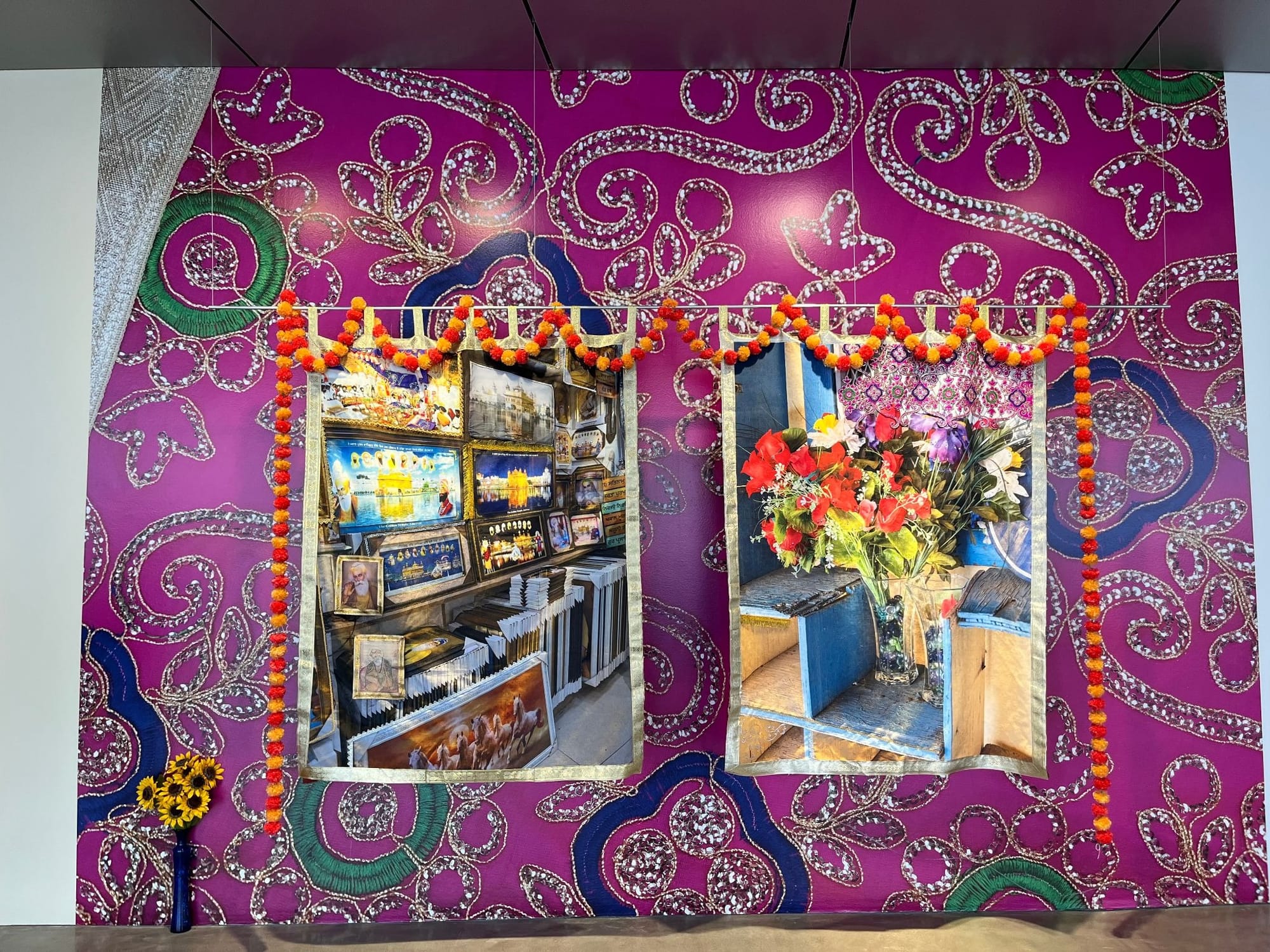
Here, Anand is not just commenting on the ironic mingling of mass-production and spiritual idolatry. These photos speak to the heavy enmeshment of religion and industrialisation, and its exploitative effects on labour economies. This is especially striking, since early Sikh philosophy condemns idol-worship altogether, according to scholars who have studied the Guru Granth Sahib Ji closely.
“Labour” itself is revisited as layered and more commonplace than we realise. Her presentation of rumala sahib fabrics bordering the large tapestries with masculine Sikh imagery encourages one to think about the role of the female population in Sikh homes. Rumaley sahib refers to the sacred cloth used to cover the Guru Granth Sahib Ji. The one used here is synthetic and made of cheap, non-biodegradable material, reflecting what is popularly sold today in the market. Her interpretation of these tapestries includes phulkari on the back, phulkari being a kind of embroidery of silk floss on hand-spun cotton, customarily made by women.
The hidden embroidery is used to illustrate the quiet, material female backbone that traditionally supports and sustains Sikh culture, and Sikh homes. This detail is poignant and purposefully hidden. Engaging with it requires straining your neck—a small but impactful moment of labour on the viewer’s part. It allows you to proverbially “peel back” the layers of what it takes to sustain the popular masculine images more visible to the public.
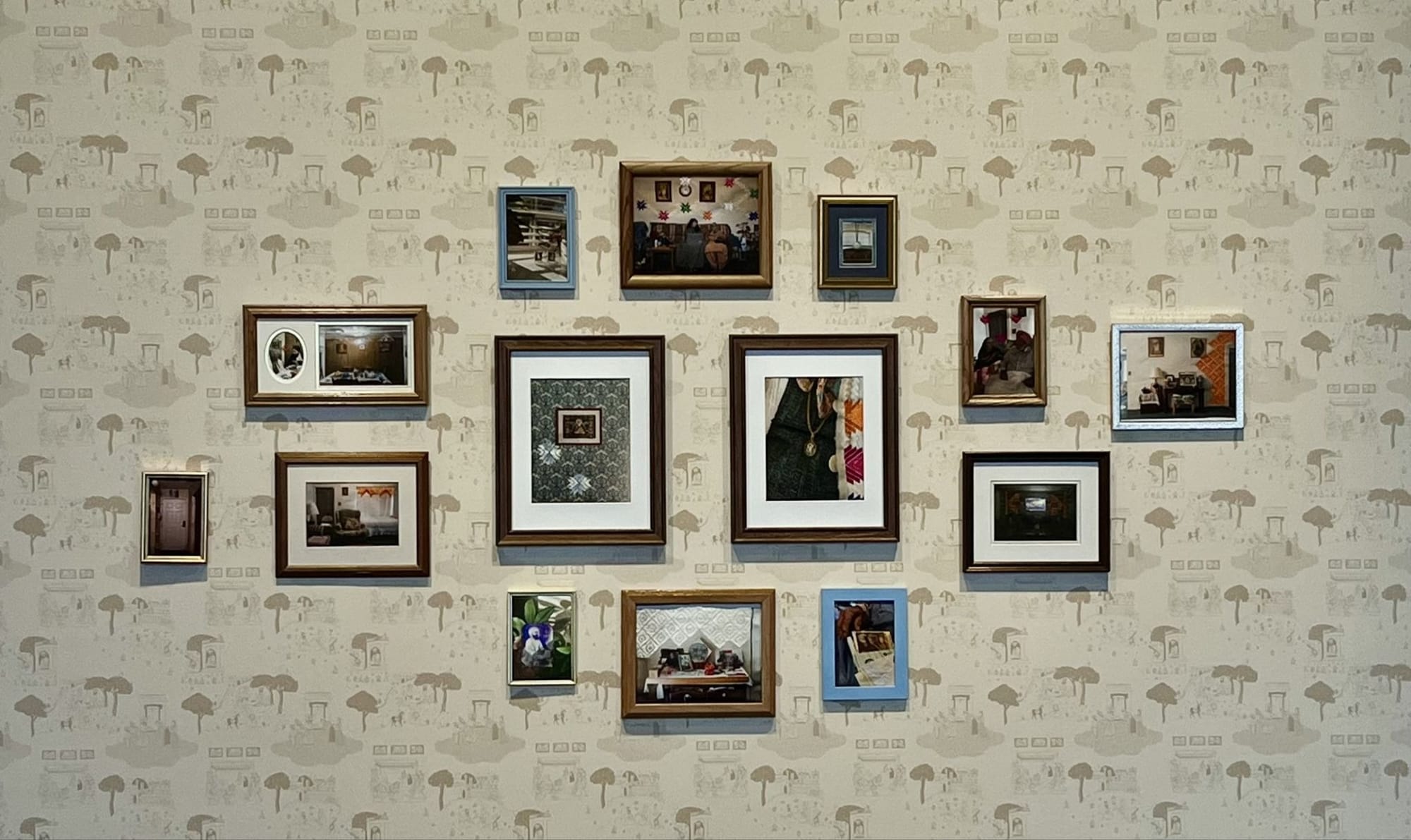
The largest element of the exhibit is a scale model of a suburban Sikh living room, complete with a couch and chair, television, and a wall full of photographs. This space is created to reflect the inside of a house in Surrey, BC, or any city with a higher Sikh population today. Here, through the television, we move from the commercial space to the domestic, and how one informs the other.
A stand-out part of the footage includes a Sikh goods-shop owner commenting on the popular demand for framed photographs of strong running horses to decorate the walls of the home. These purchase-decisions reproduce the same popular masculine iconography, and the ecological costs of keeping them.
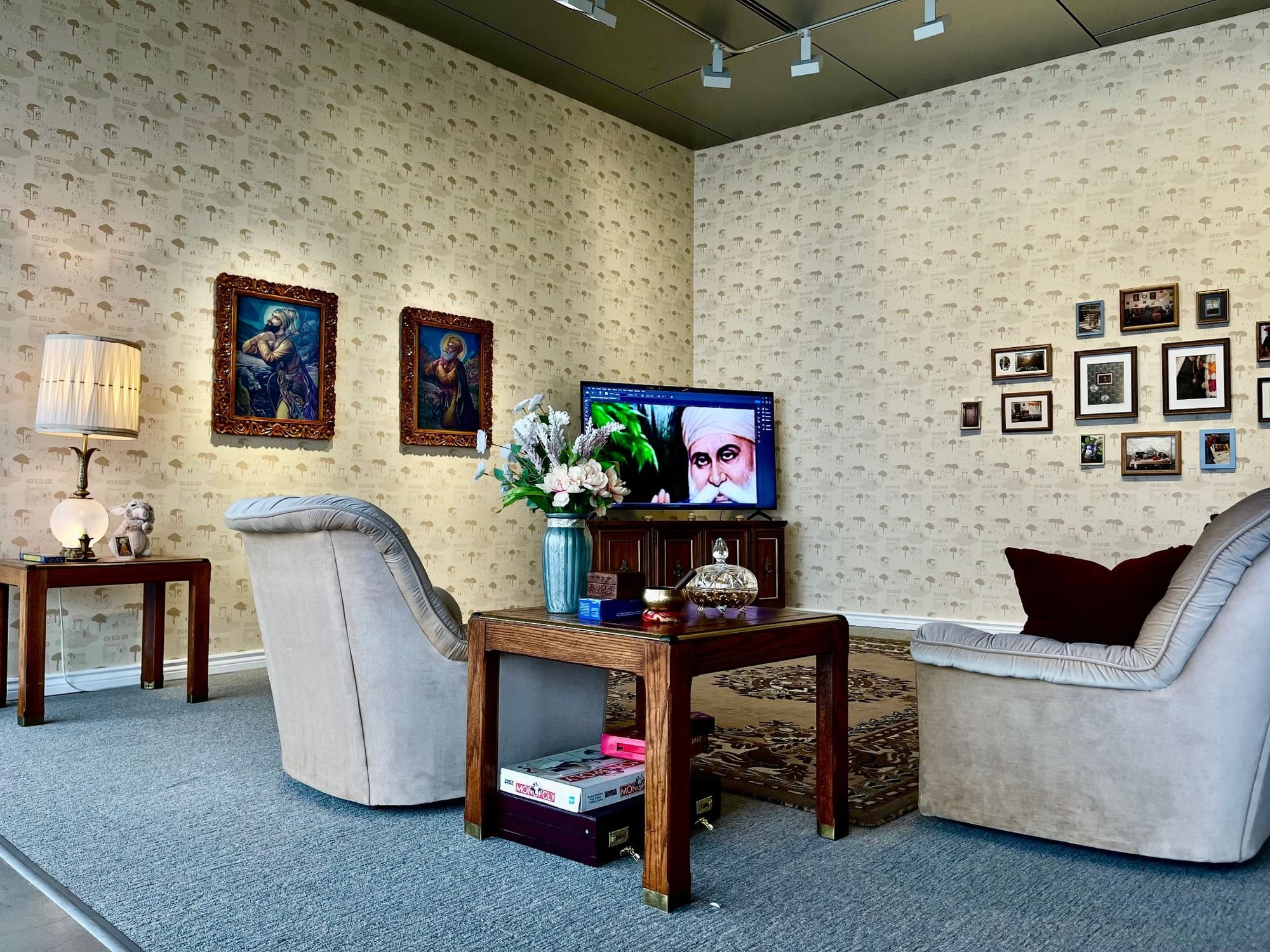
The living room wallpaper consists of illustrations from the janamsakhis, scriptures that portray the life of Guru Nanak. Popular janamsakhis leave out the stories that speak to female and queer experiences, because the ones that survived were blanched and cherry-picked by the British to keep in their museums.
Moreover, today, most of these mass-produced images are not true to the original representation of the gurus. Not only are they not simple and hand-carved, they’re inspired by Western religious art that was popular during the British colonial rule in India. Anand uses lenticular framed photos (common in many a suburban home) to show images that shift from the gurus to the image of Jesus Christ depending on the viewer’s eye, to depict this Western artistic inspiration.
What’s most interesting about this showcase is that we go from the all-encompassing idea of God and the eternal to the exploitative nature of its modern adaptation. At the same time, we actively explore the conditions that keep this visual culture alive.
In a video courtesy of Stamps School of Art & Design at the University of Michigan where she talked about this project, Anand said, “What I’m hoping that people get out of this is the understanding that all the objects in our lives, whether they’re spiritual or just the clothes we wear, become important parts of our identity and sense of self. But they’re also within a capitalist market. We all struggle with that in some way. And I’m hoping [with this work] to make that struggle more apparent.”
The question posed is simple: In the process of eternalising the divine, what are we really making permanent?
Anand’s answer is not straightforward. But it is truthful: We eternalise our impact, by employing mass-produced non-recyclable materials to perform idolatry. We solidify patriarchal structures by perpetuating male-dominated images. We put ourselves at the risk of systemically diminishing female experiences in storytelling. We edify the philosophy of capitalist mass-production and keep the machine running.
In the process of maintaining our relationship to the divine, this exhibit puts us to the task of exploring how it impacts our relationship to each other, here on the impermanent earthly realm. And this investigation, while immaterial, may bring us closer to our own inner divinity.