
Two public artworks greet visitors at the Mackenzie entrance of the Ottawa Art Gallery (OAG), one outside and one just inside. Sàgàbigonì, a banner by Kitigan Zibi Algonquin artist Stephanie Tenasco, is installed on the outside wall of the entrance from April 16, 2026, to April 26, 2028. Threshold, three suspended dragonfly wings by Ottawa artist Jennifer Macklem with studio assistant Faezeh Maleki, hangs in the lobby from January 27, 2026, to January 31, 2027.
The two works speak directly to two United Nations Sustainable Development Goals: Sustainable Cities and Communities and Reduced Inequalities. Placing commissioned art at an entrance and in a free lobby, rather than behind gallery doors, supports the first goal’s focus on inclusive public space. The second goal comes through in Sàgàbigonì, which puts Anishnaabemowin, the Algonquin language, and Algonquin artistic practice on the gallery’s exterior at monumental scale. Ottawa is built on unceded Anishinabe Algonquin territory, which the City of Ottawa’s own civic cultural document defines as land that has not been formally surrendered or transferred to another. Canada’s History adds that, unlike most of Ontario, Algonquin territory has never been covered by a land-sharing treaty.
Sàgàbigonì belongs to Anishinàbe Mazinibìhigan, Anishnaabemowin for “Algonquin Artwork,” a program developed in consultation with the Elders of Kitigan Zibi. A newly commissioned work goes up on the gallery’s exterior. It rotates every two to three years, according to the OAG’s website, to centre Algonquin voices and artistic practices. The banner combines detailed images from Tenasco’s beaded deer hide work Kìwàbandamogoban, “he/she had seen it long ago, well before my time,” with the word Sàgàbigonì, Anishnaabemowin for “sprouting.” The beadwork uses beads, fish bone, caribou hair and porcupine quills, and its floral motifs and strawberries reference long-standing practices and the month of her birth, June. The OAG says the word evokes growth, renewal, and the continued vitality of language and knowledge across generations, and the imagery recalls berry gathering and enduring practice on unceded Algonquin territory. Readers unsure how to say the title can hear it: the OAG’s page for the work includes an audio recording of the word spoken in Anishnaabemowin.
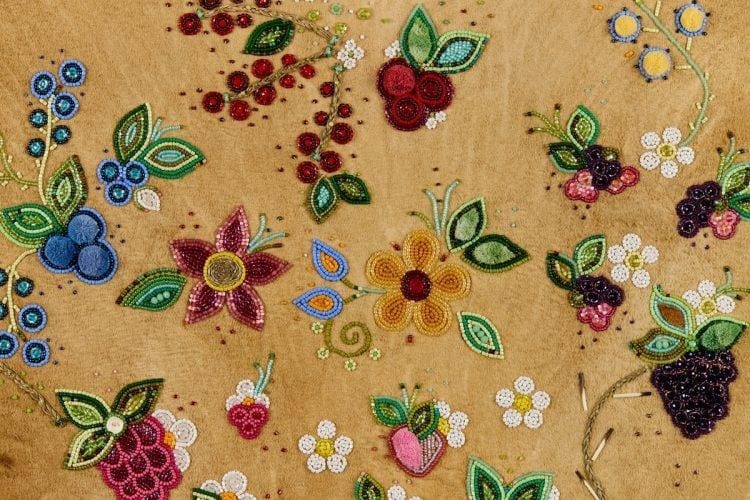
Tenasco, who is native to the Kitigan Zibi territory and still lives there, often includes a strawberry in her beadwork because it marks her June birth, Odeyimin Kìzis, the time of strawberries, according to her entry in Minwashin’s directory of artists and cultural bearers. The motif carries a wider meaning too. Describing the strawberries in a living wall she designed for the University of Ottawa, she said in a June 2024 university news story that the berry is heart-shaped and known as the heart berry in Indigenous cultures. “The artwork represents the hearts connected within the community and new beginnings,” she said. The same story describes her as an Algonquin artist from the Kitigan Zibi Anishinabeg First Nation in Quebec.
Language is a second thread in her work. According to that university story, she helped develop a multi-platform app that offers the Algonquin language in audio and written form, and she records short videos starring puppets who speak English and Anishinàbemowin. “My parents inspired me to pass on the language,” she said in her Minwashin entry.
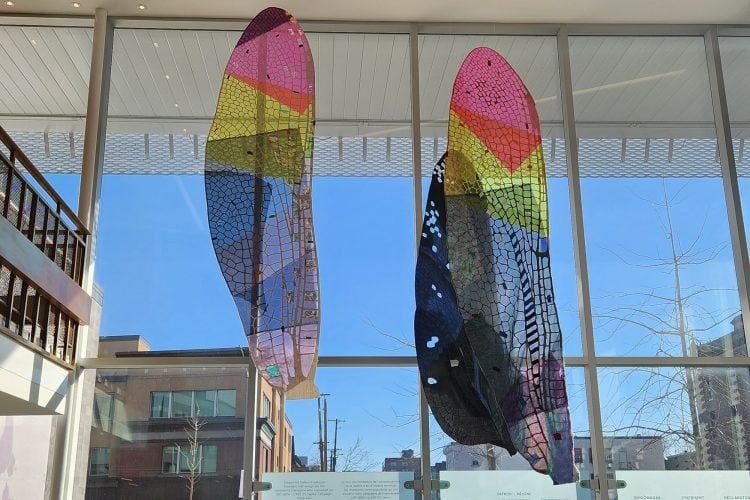
Threshold works differently. Suspended and sensitive to the movement of visitors, the wings gently spin and refract light as people pass, inviting closer observation, as the OAG states on their website. Macklem draws on scans of actual dragonfly wings, enlarging and configuring them into sculptural pieces that use microscopic detail to respond to what the gallery calls current ecological predicaments. The work is made from laser-cut cotton drop cloths, hardening resin, and recycled fabric and acrylic sheets, and it entered the OAG’s collection as a 2025 gift from Macklem and Maleki.
In a LinkedIn post about the installation, Macklem wrote that dragonflies, like many insect populations, have been declining in number during her lifetime. About eight years ago, she wrote, she began almost inadvertently to narrow her focus toward them during a lonely stretch of her life. “I had encounters; I noticed them noticing me,” she wrote.
Both works sit where visitors enter the OAG. One puts a word in Anishnaabemowin on the outside wall, and the other turns slowly as people walk past it. Both are free to see.
Sàgàbigonì by Stephanie Tenasco is on view at the Ottawa Art Gallery, 50 Mackenzie King Bridge, through April 16, 2028. Threshold by Jennifer Macklen with Faezah Maleki is on view in the lobby through January 31, 2027. Both are free.