
The Canadian Library is a unique collection of community-engaged art and learning, commemorating Indigenous people who were murdered, not found by their family and community, or those who never returned home from residential schools . The library’s motto is “Through Art. We Reconcile, Reconnect, & Rebuild”. The Sustainable Development Goal of Reduced Inequalities vividly evident in the library’s efforts and activities.
The Canadian Library is a national living memorial consisting of more than 8,000 books. Art represents each book, reflecting a life and a story. The books are individually packaged in fabric featuring Indigenous designs and motifs. These motifs are conventional patterns, symbols, and visual elements created by Indigenous peoples to express their beliefs and philosophy. Figures like the eagle, bear, and wolf signify different beliefs across Nations. Circles, dome shapes, and interlocking lines represent the universe. Every shape, line, and colour tells a precise story about ancestry or creation.
The books are dedicated to Missing and Murdered Indigenous People and children who never returned from residential schools. Their names are written in gold lettering on the spines of the books. The Canadian Library uses a Cricut machine to etch the names onto gold-coloured mats. These are heat-transferred to vinyl and then ironed onto the spines of the books. The collection creates a powerful, creative, visual image.
Mary Lou Smoke is a longtime Indigenous advocate and member of the Ojibway Nation. Smoke was gifted a book by The Canadian Library that was wrapped in fabric that had raspberry designs. In Ojibwe culture, the raspberry holds deep spiritual meaning. As the sweetness of the fruit is protected by thorns, Indigenous artists use raspberry motifs to depict the balance between compassion and the necessity of self-protection and boundary-setting. The book bore the name of her sister in gold etching. Her sister, Debbie Ann Sloss-Clarke, was murdered in 1997. “I’m never going to let the world forget what happened to my sister,” Smoke said. “And now people aren’t going to forget because you’re going to see her name on those books.”
Leslie-Anne Steeper-Doxtator, supervisor at the Middlesex County Library’s Coldstream Branch, gave the book to Mary Lou Smoke. Steeper-Doxater also has a personal connection with the Canadian Library book art endeavour. Her Indigenous partner was part of the residential school system.
The books contain a QR code that people can follow to learn more about the people and their lives. The books represent the women and girls who never had a chance to tell their story.
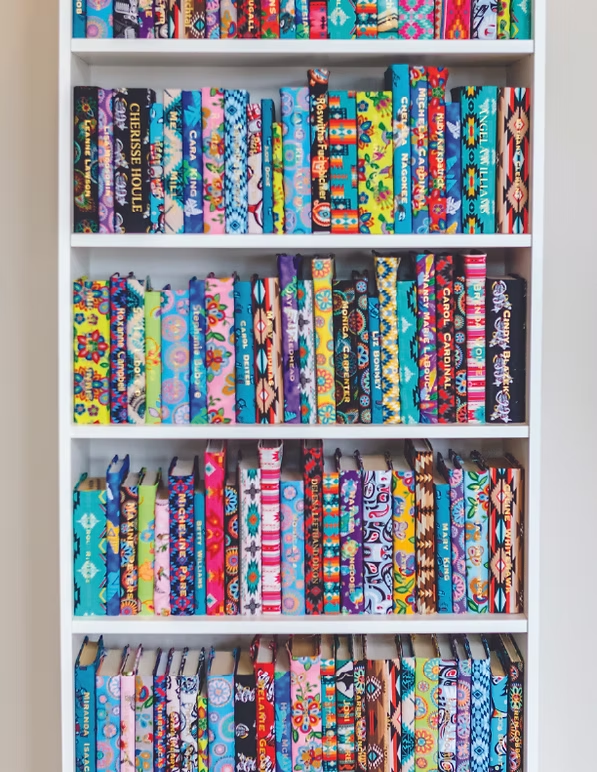
The fabrics, with their designs and motifs, chosen to cover the books, are purchased from Indigenous stores and businesses. This is to ensure sustainable economic growth, productive employment, and decent work for all.
For an average book size (6 x 9 inches), one meter of fabric can cover around six books. Through the artful presentation, the gold lettering of names, and the unique life stories of the Indigenous people represented in the books, The Canadian Library is instrumental in fostering understanding of inclusive and equitable quality education and lifelong learning opportunities for all people for meaningful change.
A very interesting project is the ‘Micro Galleries’. It includes a mapping of the collection in various regions. The library encourages community members to include art, poetry, and anecdotes of their association with Indigenous people. These are artfully assembled in a book and displayed in institutions, community hubs, and churches. The mapping provides a clear idea of the location where the books are displayed and the content of what is displayed. In this way, the Canadian Library aims to encourage meaningful discussions about reconciliation and a responsibility to respect and reminisce about Indigenous history.
Equally interesting is the anecdote of how The Canadian Library established itself. A meagre fund was collected by a group of women who intended to create a small library for the Toronto-York region. A tall bookcase was purchased for this purpose. The owner had kindly consented to deliver the bookcase. In between conversations, it was learned that her mother was a Shingwauk Residential School survivor. This became an extremely powerful incentive to start the library with books to honour and learn about Indigenous history. What started as a few women wanting to help educate each other led to the creation of a beautiful living memorial and an educational institution to promote equitable learning.
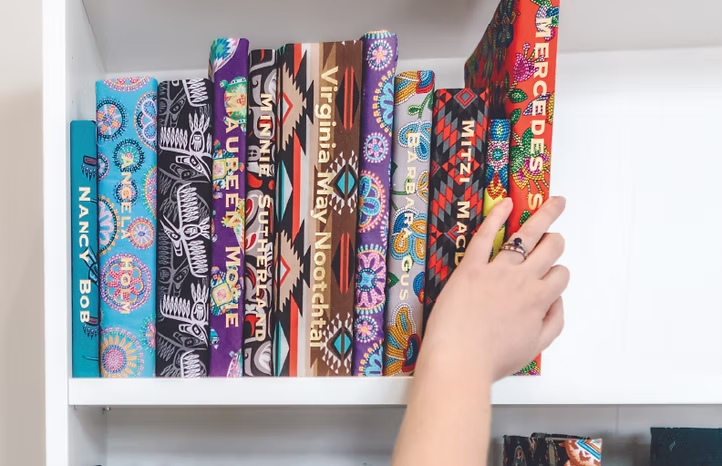
The Canadian Library continues to collaborate with Indigenous friends and community members who help guide meaningful learning while continuing to support Indigenous families. IKEA is the first retail partner to embrace the project. IKEA displays Indigenous art installations from September 30 to December 31.
The Canadian Library’s collaborative art-and-learn effect is also found in public libraries, schools, and colleges. Since 2023, Humber College in Toronto has marked a ‘Red Dress Day’ to raise awareness about missing and murdered Indigenous women and girls. Special events, such as Indigenous author visits, are observed. Sarah Lewis, an Anishnaabe Kwe (Cree) spoken word artist, activist, and community organizer, had graced an annual event there.
The Canadian Library has gained a repute through the distinctive designs and vibrant colours of the Indigenous fabrics used on the book packaging. The artful cover serves as a powerful reminder that each book embodies a unique life, a cherished individual, and a story worthy of remembrance.
Through the splendour and imagery of the fabrics, the Canadian Library invites every visitor to pause and remember the missing and murdered Indigenous people. The library’s art and learning combined are instrumental in providing a deeper understanding of truth, remembrance, and reconciliation.
As activist and founder Shanta Sundarason puts it, “It’s an initiative to start difficult but very important conversations to share.”