
For its first anniversary, KLEO Seminyak handed its lobby atrium to one Balinese artist Ngakan Putu Agus Arta Wijaya, who is better known by his abbreviation NPAAW. Layers, Unmasked opened on 13 August 2026 and is curated by independent art writer and curator Savitri Sastrawan under the title A Transformation, A Transition, An In-Between. Four bodies of work fill the space: Penumbra, Mandala, and Wave and Cocoon. They have all been built from spray paint, glue and masking tape cut into strips as narrow as five millimetres. NPAAW's studio in Gianyar recycles the material of every painting so that nothing goes to waste. This is aligned with the United Nations Sustainable Development Goal of Responsible Consumption and Production.
To read these surfaces properly, it helps to trace what their colour compositions allude to, which can be traced back to the Color Field movement of the 1950s, which grew to influence what is now known as Pop Art. Ritesh Ranjan's critical analysis of the Pop Art movement locates the movement's core in an "emphasis on strident color, a playful attitude to scale," and in patterns of repeated abstract shapes — the formula by which its artists refused to treat the art object as sacred and continuously redefined it instead.
In fact, Richard Hamilton's 1957 definition of pop reads like a materials list for NPAAW's studio: popular, transient, expendable, low cost, mass produced. Think of how Roy Lichtenstein took the Ben-Day dot straight from commercial printing and Robert Indiana pulled his palette from road signs and billboards. NPAAW inherits all of that, then removes the need for a picture or an easy to identify signifier.
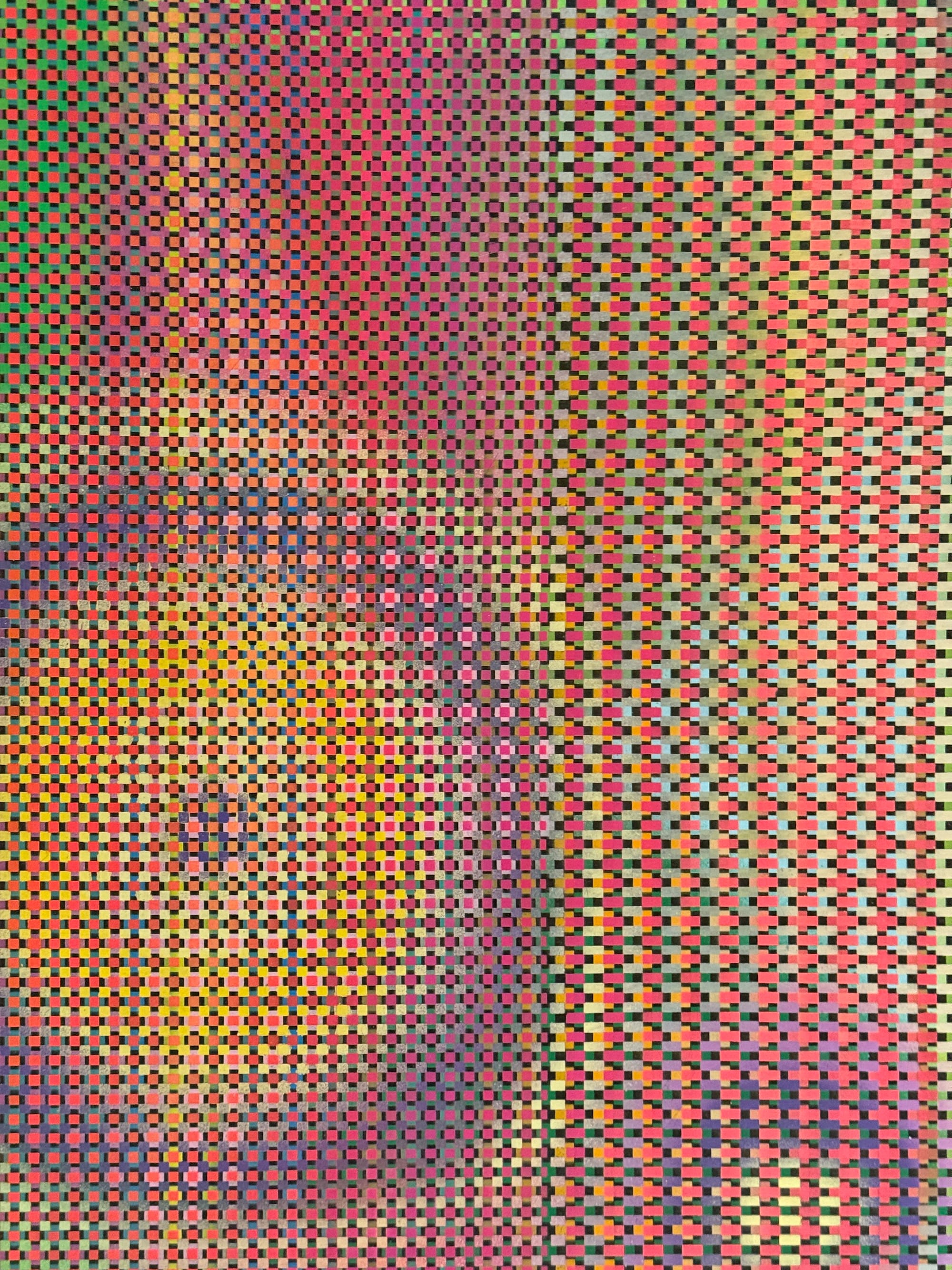
His palette is dictated by whatever the aerosol factories manufacture, which is as close to Warhol's logic as a Balinese studio is likely to get—except that where Warhol printed Marilyn, NPAAW prints out square patterns made by his orderly way of laying out tape. The resulting grid echoes Takashi Murakami, whose checkered backgrounds reminded the artist of the transparency checkerboard Photoshop uses to signal empty space. NPAAW recognised in that signal not emptiness but a proposition: a canvas with no edges.
He also recognised something older. The same grid is poleng, Bali's sacred black-and-white check that wraps guardian statues and banyan trunks, and his layered surfaces echo the traditional rangrang weaving technique— associations Ubud Open Studios drew on when the festival selected his work as its official 2025 artwork. A former mathematics and physics student, NPAAW does not paint temples or offerings. To him, Bali arrives structurally via order, patterns, and the emotions invoked in-between.
NPAAW is not the first Balinese artist to build abstraction out of that inheritance, and the show reads differently once he is placed in a lineage. The obvious precedent is Made Wianta (1949–2020), the Tabanan-born painter who studied and dismantled the classical Kamasan wayang traditional art style after studying it from masters in Klungkung, Bali. Wianta's career divides into phases that could serve as chapter headings for NPAAW's: a Quadrangle period of geometric compositions in mixed media and a Dot period in which, having dropped figuration, he painted "a kind of abstraction that systematically used small dots of colour with a mixture of linear contours and flat surfaces."
Broken Triangle (1990) and Golden City on Blue (1995) show him doing what NPAAW now does with tape — imposing a rigid system, then letting calligraphic marks and gold leaf disrupt it. Wianta made some 14,000 works, reached the Venice Biennale in 2003, and is remembered in Bali as the artist who proved a Balinese painter could work outside the realm of "Balineseness" without ceasing to be Balinese. NPAAW's line that Bali is simply in the way he breathes is Wianta's argument, restated by a generation that no longer has to win it.
Two figures from the wider Indonesian canon sharpen the picture. Fadjar Sidik (1930–2004) spent four decades on a single series, Dinamika Keruangan—The Dynamic of Space—repeating simple geometric modules to register movement and change and constructing what the 2024 Venice Biennale called a visual language for an age of urbanisation and industrialisation. He lived in Bali from 1957 to 1961. NPAAW's Wave and Mandala canvases are that project's grandchildren: modular, non-representational, and concerned with the behaviour of space rather than the appearance of anything in it.
Ahmad Sadali (1924–1987), of the Bandung School, supplies the material half. Sadali understood texture as the residue of "various forces and processes in nature; tension and shrinkage, cracking and breaking, peeling and tearing, erosion and weathering." Substitute a studio in Gianyar for nature, and that is a specification for the Cocoon series. Sadali built his surfaces with gold leaf and accreted paint; NPAAW built his with adhesive and a lifted edge. Both are painters for whom the event is whatever happens to the skin of the picture.
Containing mostly new works, the 2023 made Penumbra is NPAAW's oldest work in the show and the clearest bridge to Lichtenstein. A reclining shape surfaces and dissolves across a field of coloured dots, legible from across the Atrium and unreadable up close, exactly as a comic panel behaves under magnification. Where Lichtenstein enlarged the dot to expose mass reproduction as a style, NPAAW enlarged it until the source image drowns. The title names a half-shadow—the zone that is neither lit nor dark—and the painting sits in it, holding an image it will not fully surrender.
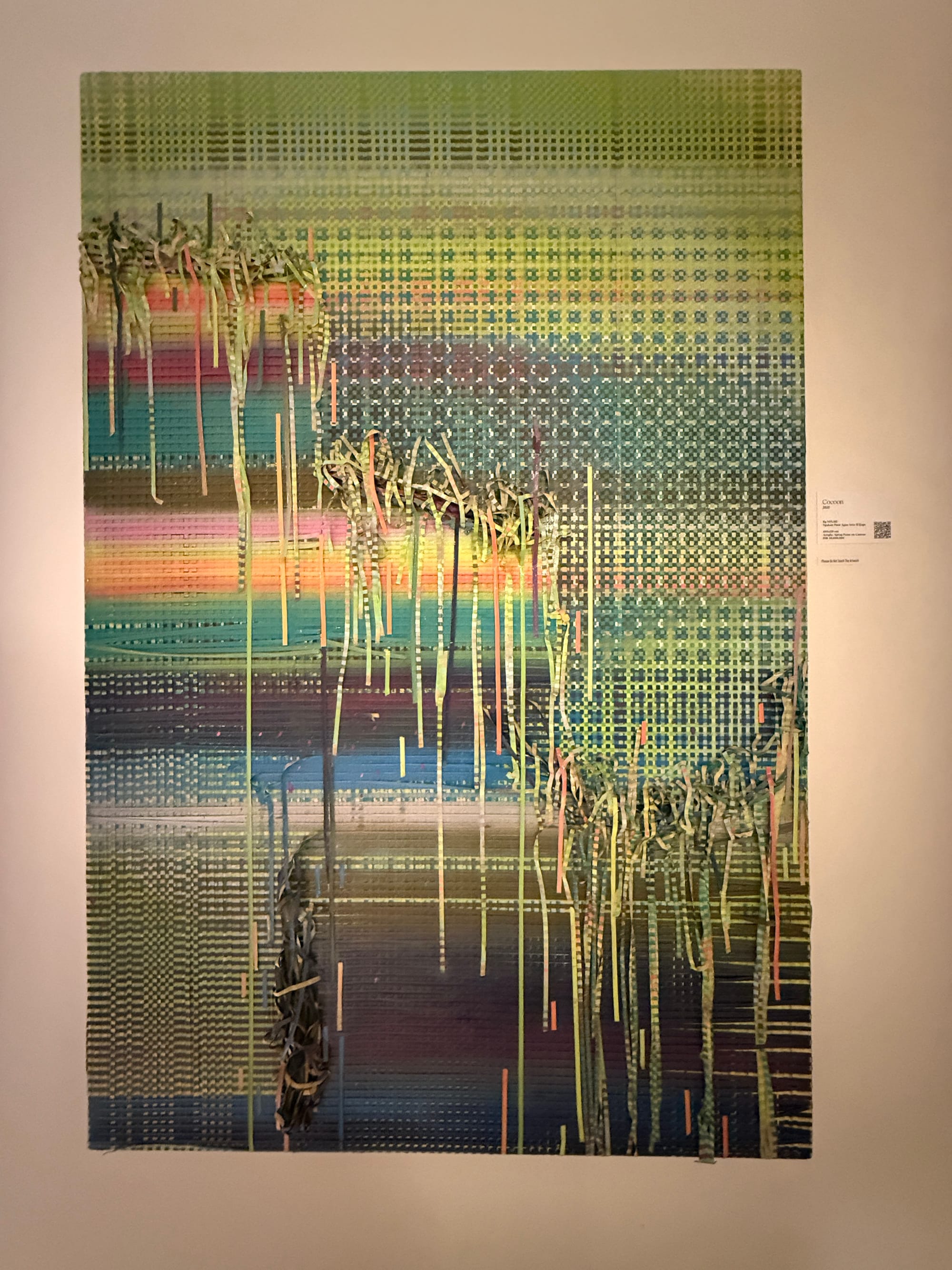
By Wave, any sort of recognizable figure is gone. These are the most purely optical paintings in the exhibition: green and blue currents in one canvas, sunset oranges and acid greens in another, all pulled through a woven grid until the colour appears to move. Nothing here is a picture of water. The wave is an event happening between the viewer's eye and a surface of interfering squares, which places these canvases squarely in the territory the Tate research describes, where pop's commercial colour and op art's perceptual games shared both a decade and a paint supplier.
Mandala turns that interference outward from a centre. Pinks, oranges, and golds radiate through a dense weave in a work that reads as devotional geometry rendered in aerosol. It is a fair summary of NPAAW's whole position: a form carrying centuries of spiritual weight, executed entirely in the colours of a hardware shop.
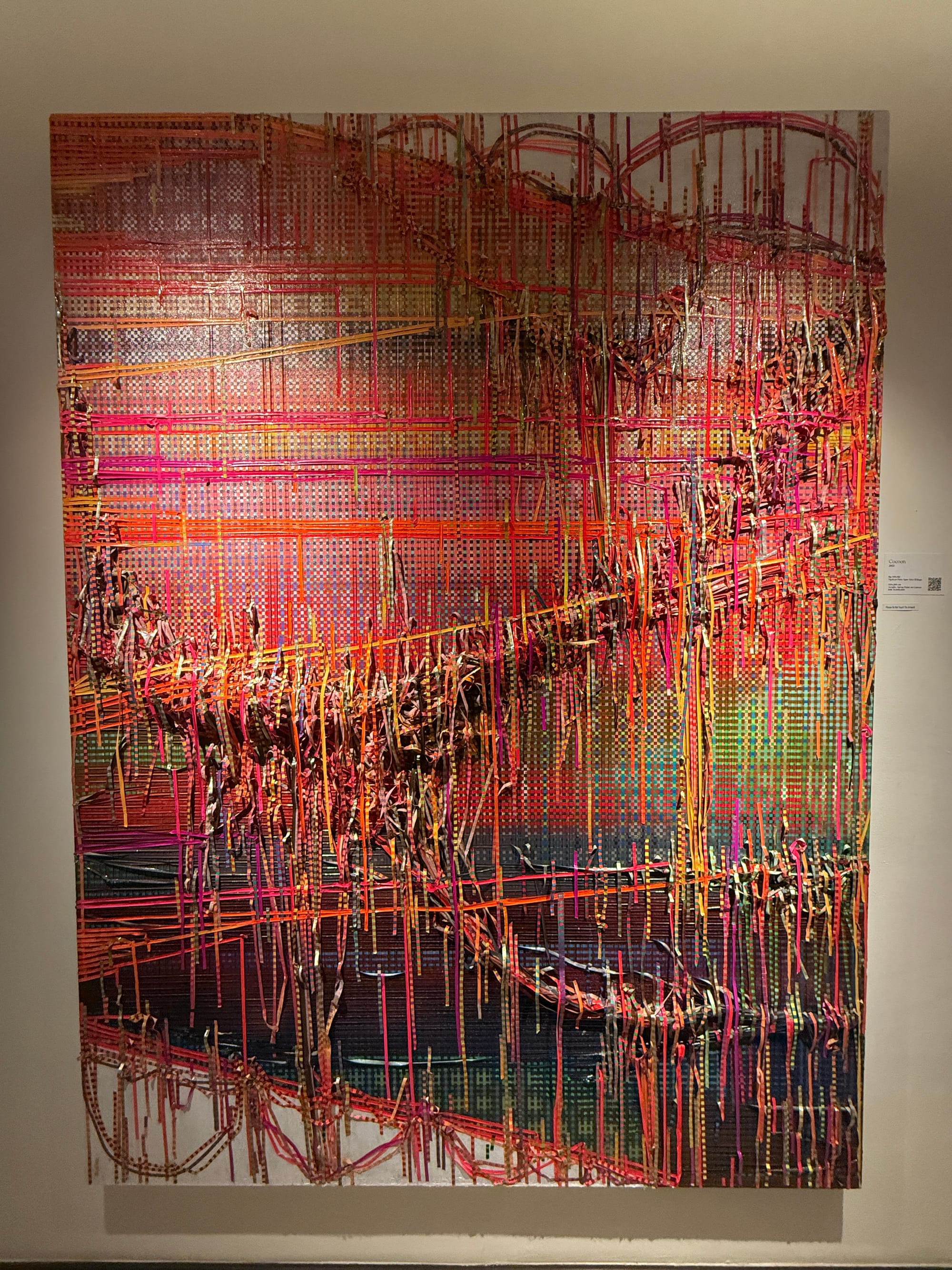
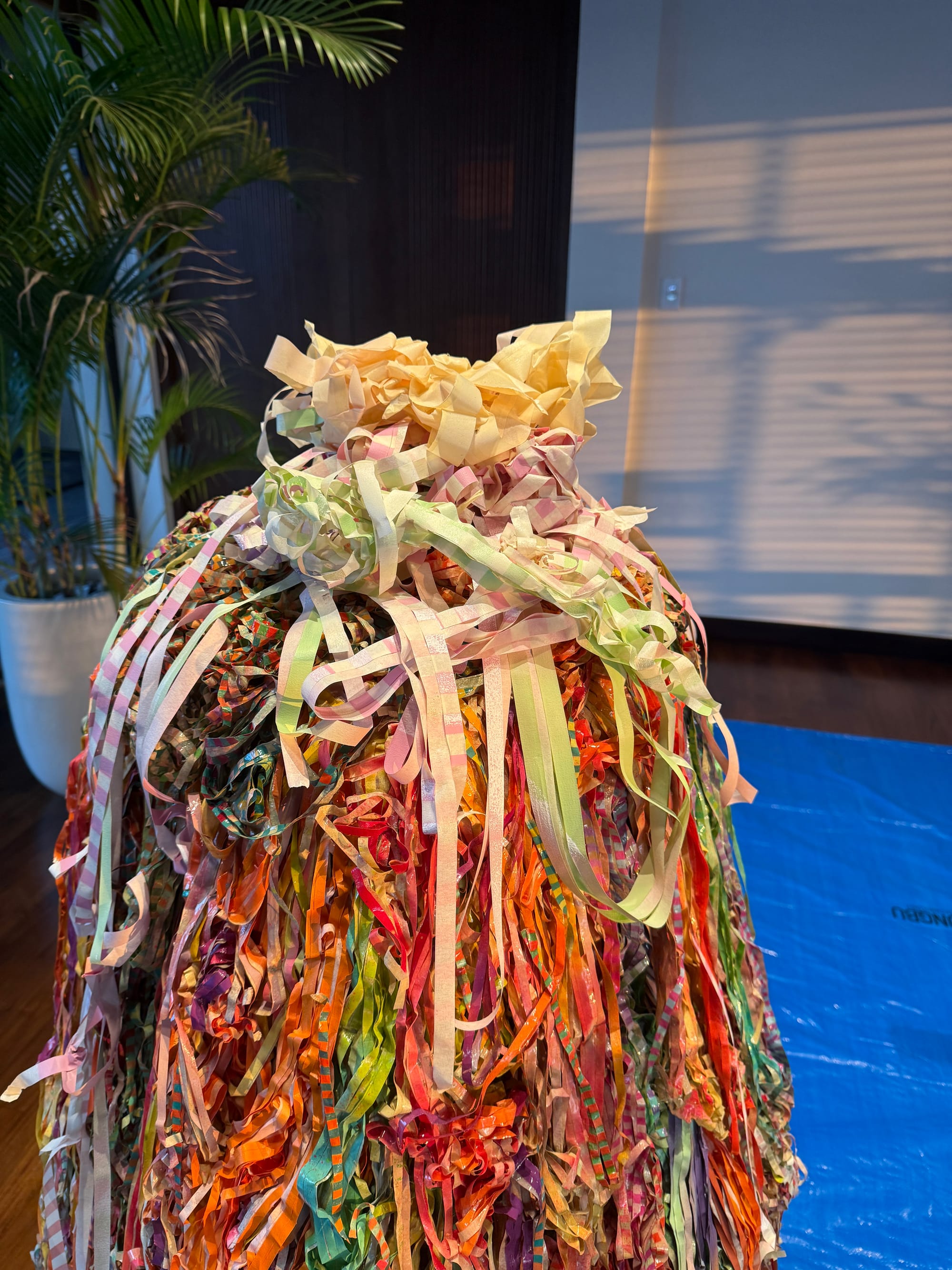
The pivot comes with Mandala Cocoon. A radiant disc still anchors the composition, but tape strips now burst past its edge in loose, spiky rays that cast real shadows on the canvas. The painting has stopped being flat. This is where NPAAW's stated ambition becomes visible—his description of moving from square meters to cubic meters and from there toward a fourth dimension in which shifting daylight makes the work different every hour.
The Cocoon canvases carry that argument furthest. Across these works made in 2025 and 2026—sized from 100 × 150 cm up to 200 × 200 cm—lies a field of orange and violet. Where peeled tape hangs off the surface in dense fringes. Some strips have been lifted only halfway, revealing one buried layer while still concealing the next. At the exhibition’s opening, visitors were invited to peel away similar pieces themselves. What lay underneath, the artist has said, he did not know either.
“I see metamorphosis as a process that never ends. A cocoon becomes a butterfly, the butterfly dies, new eggs are laid, they transform into caterpillars, then into cocoons again, and the cycle continues endlessly,” says NPAAW.
His formulation for painting follows: technically, a work is finished when it is signed. Conceptually it never is, because it keeps being covered and layered.
Out of low-cost industrial materials, salvaged offcuts, and a grid that belongs equally to Photoshop and to poleng, NPAAW has built a visual language that keeps a Balinese structural inheritance in circulation while feeding the island's contemporary creative economy. Walk through the squares and they seem to follow you. Whether you are chasing them or they are chasing you, as the curator asks, is entirely the point.