
Inside a committee room in the Senate of Canada Building, a painting of an old railway bridge hangs where senators debate national policy. The bridge in the painting no longer carries trains. It carries pedestrians and cyclists between Ottawa and Gatineau, and it has quietly become one of the clearest examples of what a sustainable city can look like.
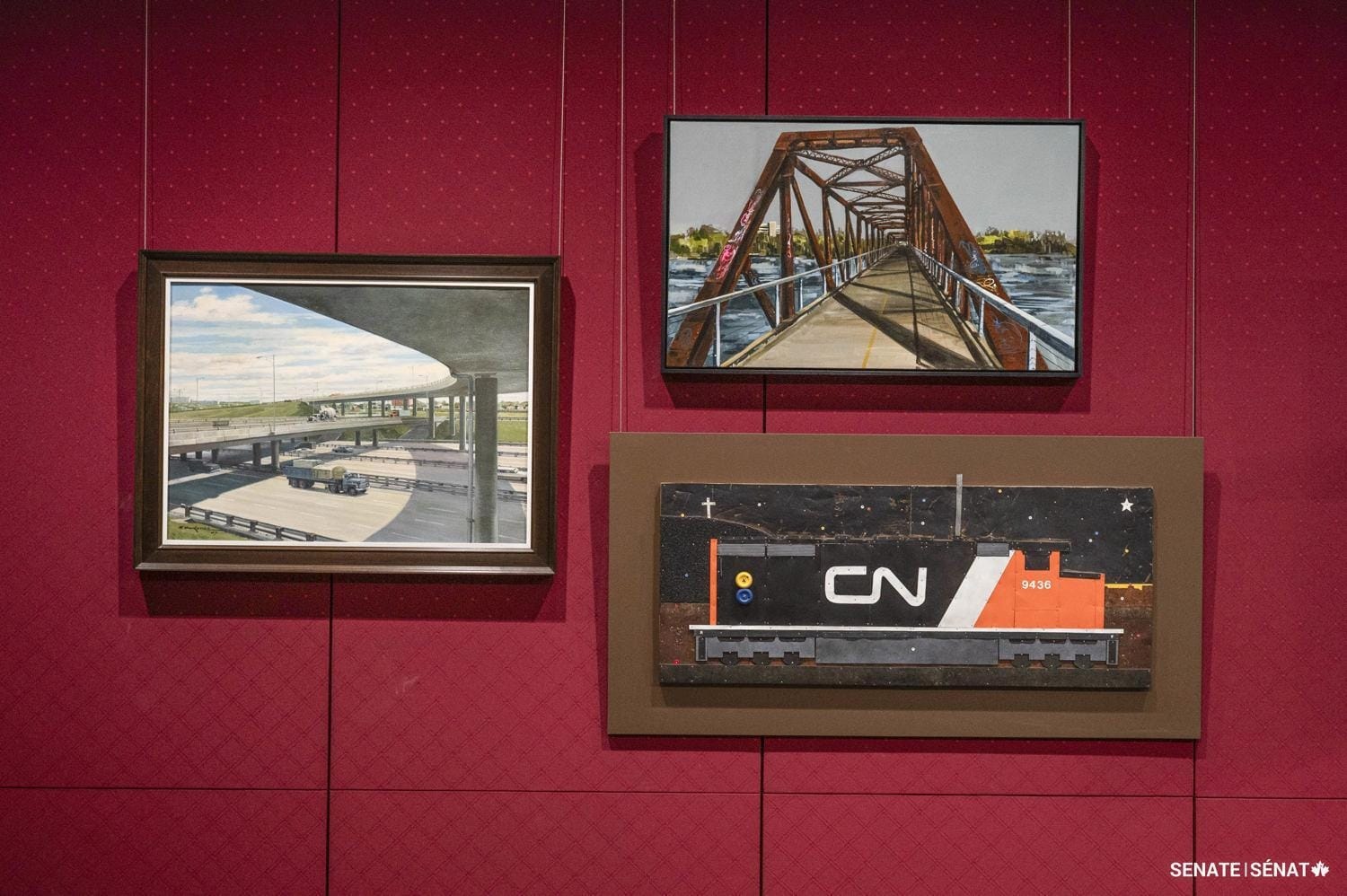
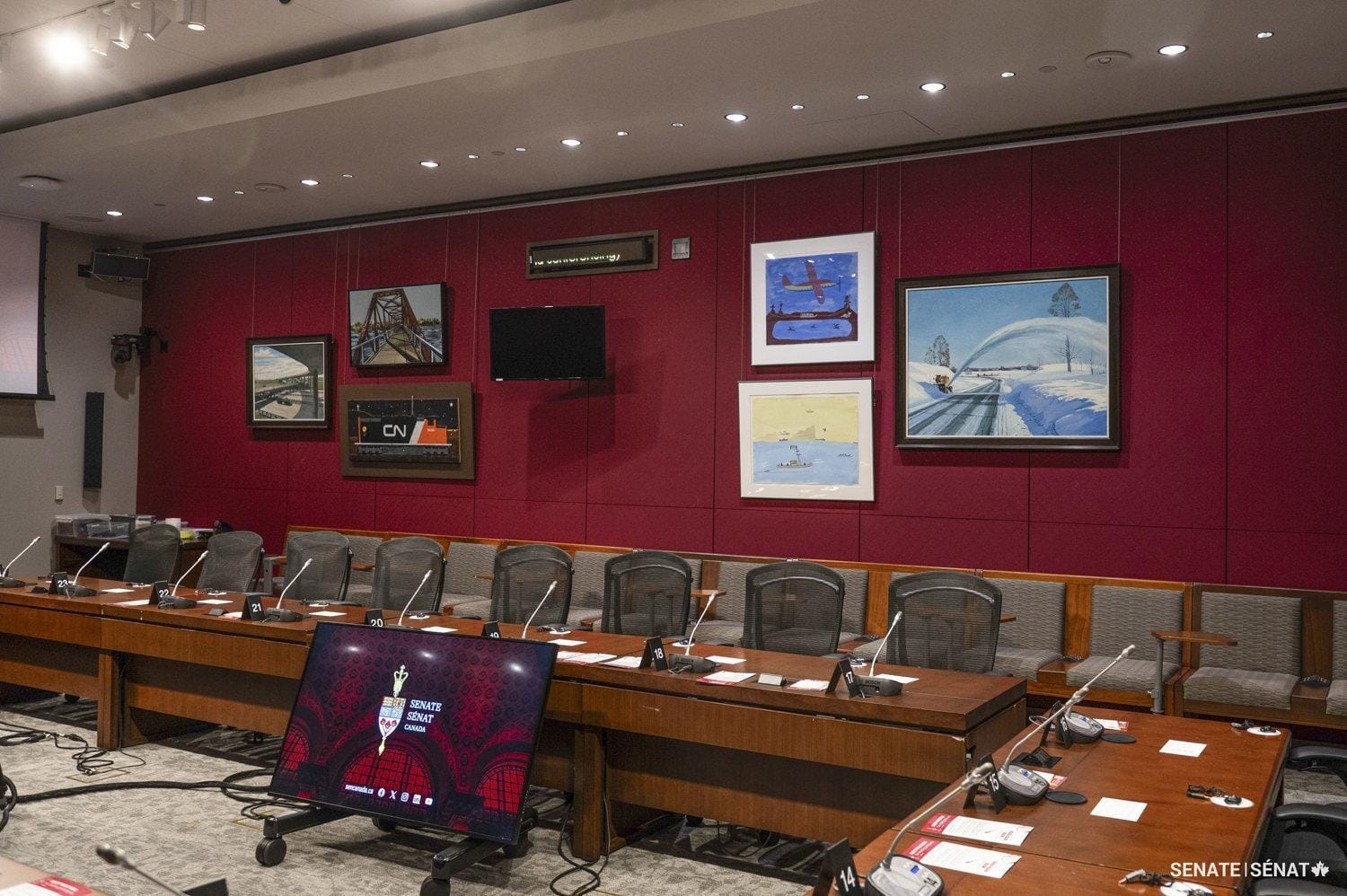
The painting, Commanda Pedestrian Bridge, is the work of Ottawa artist Eryn O’Neill, and it is one of six pieces featured in Visual Voices 2026, a rotating exhibit installed in the Senate Building from February 2026 through early 2027. The show, now in its fourth edition, brings together four Canadian artists exploring how people and cargo move across the country by land, air, and sea.
O’Neill’s contribution speaks directly to two United Nations Sustainable Development Goals: Sustainable Cities and Communities and Climate Action. The Chief William Commanda Bridge, the structure at the centre of her painting, was once a working rail line. It reopened in 2023 as a car-free pathway connecting the two cities, providing pedestrians and cyclists with a direct interprovincial route without requiring a car or bus. Both goals are tied to the same shift: a bridge built for walking and cycling instead of vehicle traffic is a small but concrete example of lower-carbon urban mobility, and turning that piece of infrastructure into a public artwork inside a federal building puts accessible, climate-conscious city planning on display for the people who shape national policy.
Born in 1985 and based in Ottawa, O’Neill is currently pursuing a PhD in cultural mediations at Carleton University. On her website, she describes her practice as an examination of “construction landscapes, temporary infrastructure and the shifting experience of pedestrian movement.” Much of her recent work follows Ottawa’s Light Rail Transit expansion, documenting the fences, detours and excavation sites that shape how people move through a city mid-transformation.
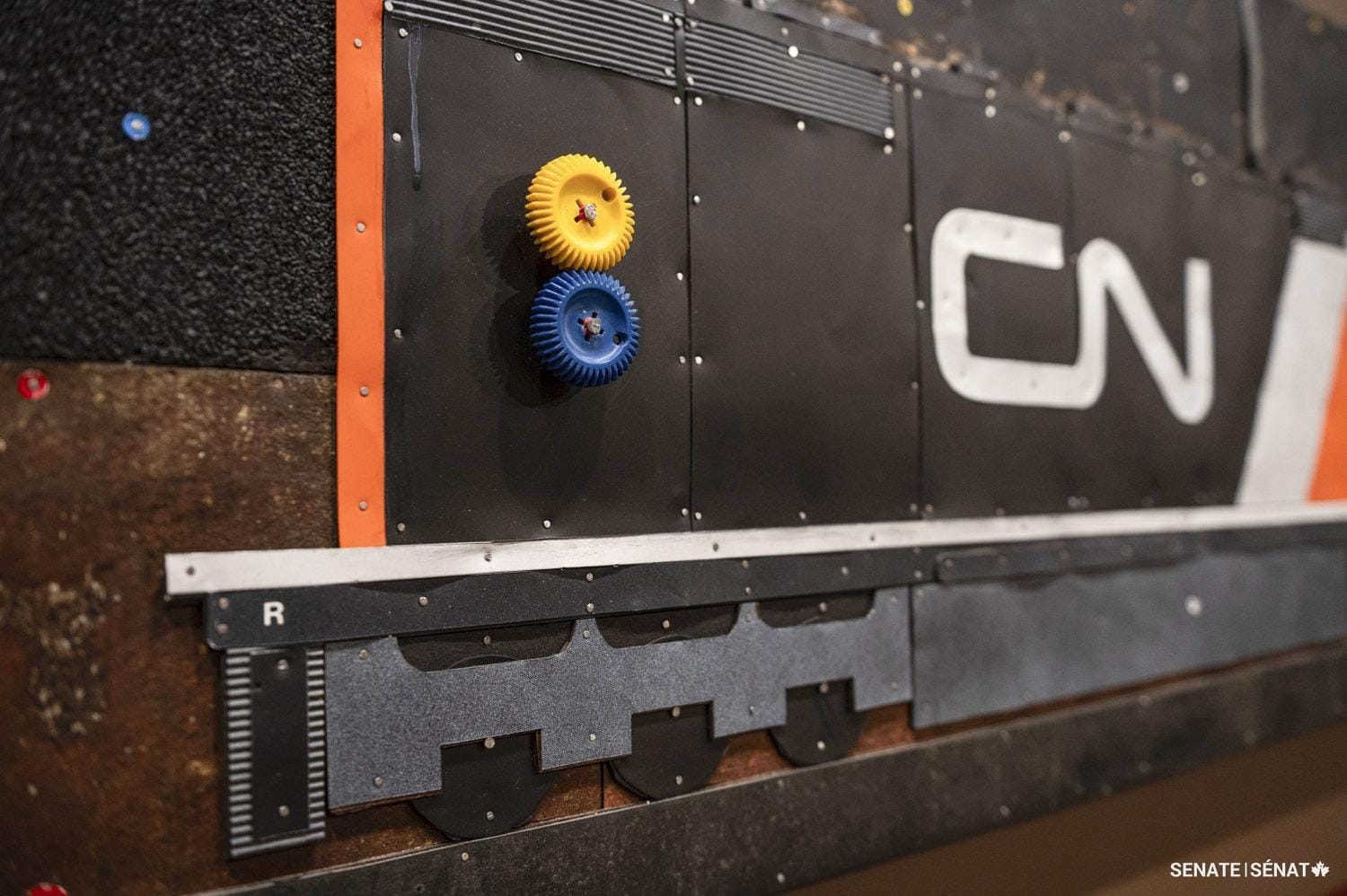
O’Neill’s painting is exhibited alongside work from three other artists. Métis-Acadian artist Eric Walker’s mixed-media collage, Point Saint-Charles Interactive, follows a Canadian National locomotive through Montréal, underscoring the railway’s role as a shipping artery. Inuk artist Pudlo Pudlat’s untitled 1970s drawings depict travel by plane, sled, and boat across Nunavut, pointing to how distance and season still shape mobility in the North. Serbian-Canadian painter Moma Markovic, who worked for Ontario’s Ministry of Transportation for 15 years, contributes two oil paintings of provincial road infrastructure. Together, the four artists frame transportation as something that is never just functional. It is tied to identity, geography, and, increasingly, to how sustainably a city or a country chooses to move.
Senator René Cormier, a member of the Senate’s Artwork and Heritage Advisory Working Group, which oversees the Visual Voices program, made that case in comments shared with the Senate’s own SenCA+ magazine. “Art plays a fundamental role in the documentation of Canadian history,” he said, describing the exhibit as more than decoration for a committee room.
Cormier’s point is that art documents Canadian history and the environments that shape it; it runs both ways in this exhibit. Markovic’s highway interchange and Pudlat’s sled crossings capture how Canadians used to move. O’Neill’s bridge captures a shift already underway: cities quietly converting old infrastructure into low-carbon, people-first spaces.
Commanda Pedestrian Bridge makes that shift visible in its materials. The steel trusses are rendered in weathered rust and burnt orange, and the old yellow traffic line still runs down the middle of what is now a path for pedestrians and cyclists only. Pink, blue and orange graffiti tags scatter across the beams. Behind the structure, a flat grey sky sits over a blue-grey river and a green, tree-lined shoreline.
In the committee room, the painting hangs against a deep red wall, an unplanned echo of the Senate chamber’s own signature colour. The Chief William Commanda Bridge did not need to be reinvented from scratch. It needed to be reimagined, one plank at a time, for a different kind of traveller.
For Ottawa residents who cross that bridge on foot or by bike without a second thought, seeing it reframed as art inside the Senate turns a familiar commute into something worth pausing on. What makes Commanda Pedestrian Bridge work is that O’Neill never lets the viewer stand back from it. There is no wide shot from the riverbank, no postcard angle; she puts the viewer on the deck itself, mid-crossing, looking down the same weathered rails and spray-painted trusses a cyclist or dog-walker would pass every day.
The most sustainable infrastructure in a city is not always the newest. Sometimes it is the oldest bridge in town, given a second purpose.
The Visual Voices 2026 exhibit, which highlights Canada’s transportation infrastructure, is on view in the Senate of Canada Building in Ottawa through early 2027.